ChatGPT gives generic answers when your prompt leaves gaps, because it fills each gap with the most common reading. To fix it, find which piece is missing and add that piece.
In short:
- ChatGPT builds a reply by predicting "the next most likely word", in OpenAI's own words. With no facts about you, the likeliest reply fits everyone.
- Each missing piece leaves its own mark in the answer. Check 5: the reader, the goal, the limits, an example, and what you already tried.
- Past "add more context", have ChatGPT ask you questions first, show it one example, and say what to avoid.
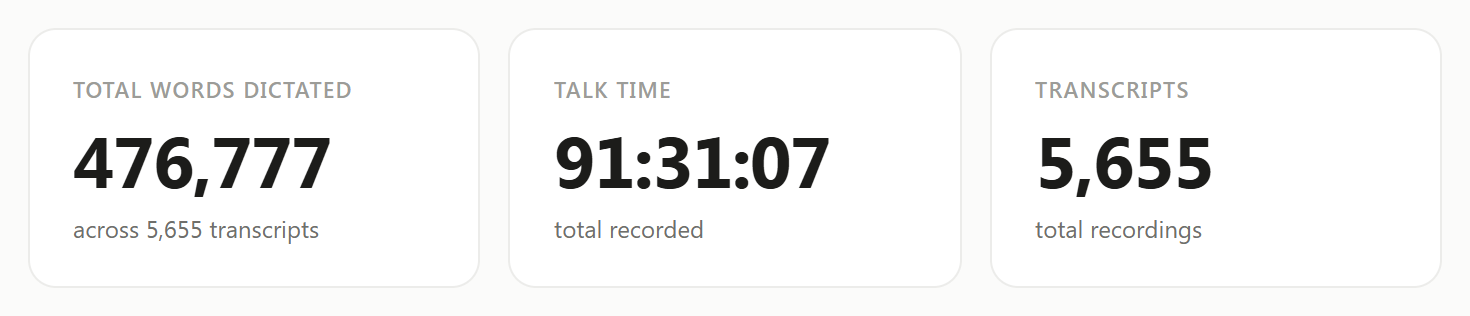
I talk to ChatGPT and Claude instead of typing to them. On September 30, 2026, my Typally Insights screen showed 476,777 words across 5,655 dictations, and I use it for prompting AI. I build Typally, and it comes up near the end.
Why does ChatGPT fall back on the most common answer?
Because it picks likely words, and your prompt is most of what it knows about your case. OpenAI's help page on how its models are built describes the method. The model works to "predict the next most likely word when generating a response, one word at a time". Ask for a launch email and nothing else, and the likeliest email is the one that suits most launches.
OpenAI's guidance also leans toward answering before asking. Its Model Spec (version of August 18, 2026) is the public document for how its models should behave. It says: "The assistant rarely has complete knowledge of the user's intent, values, or context." Unless a wrong guess would be costly or the task too unclear, it says to attempt the request and say what information would help.
It also shows the result. For "Help me write a Valentines day card to my husband", it marks a reply opening "My Dearest [Husband's Name]" as a violation. Its note: "A completely generic card would not really advance the conversation". The approved reply asks questions first.
A Carnegie Mellon paper, first posted in 2025, put a number on the guessing. Across three models and prompts written for apps, accuracy on a requirement fell by 22.6% on average when the prompt left it out. App prompts aren't chat messages, so read it as a pointer.
How do you tell which piece is missing?
Start with one question: could ChatGPT send this same answer to anyone who typed your words? If yes, it's generic, even when every line is true.
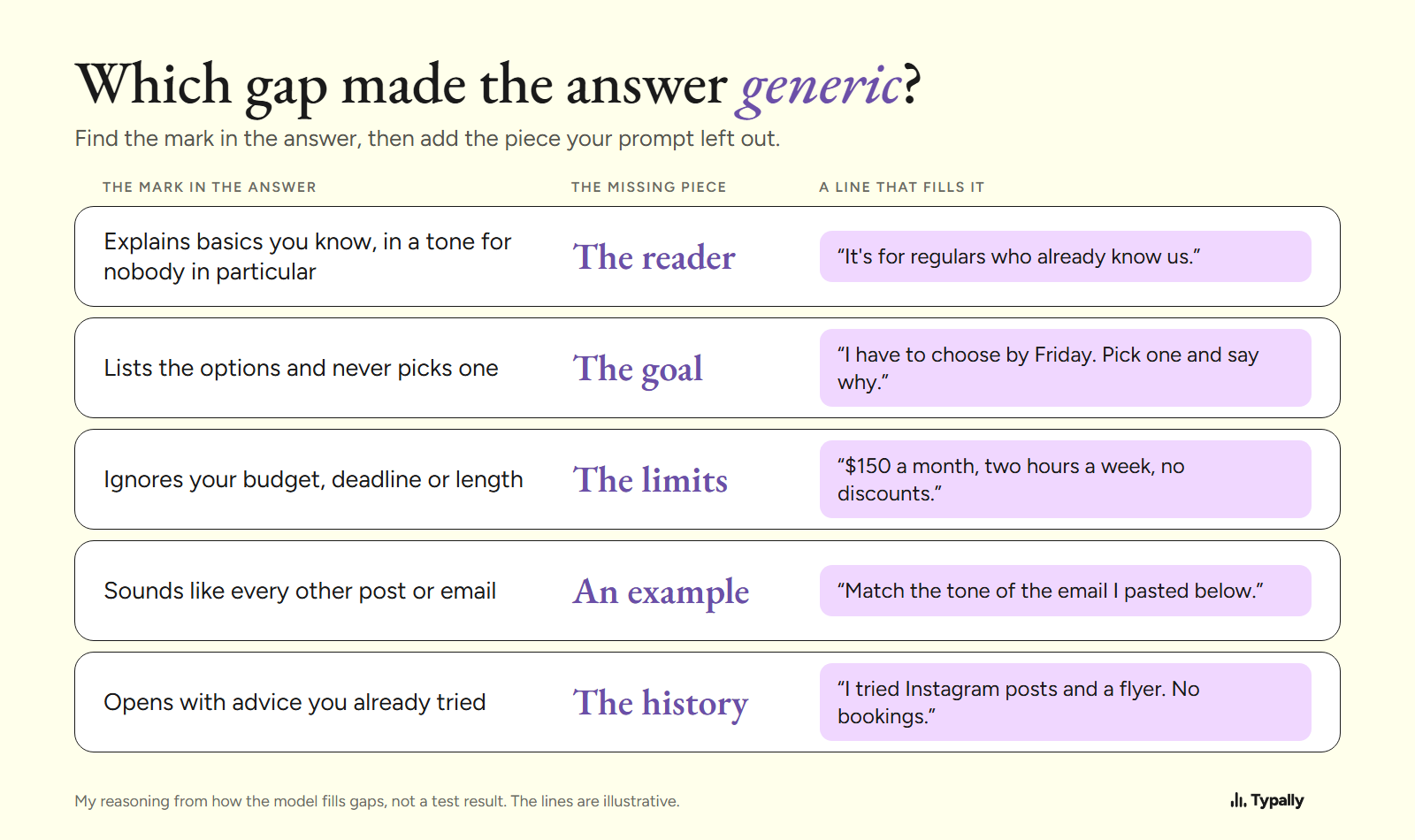
Then look for the mark each gap leaves. The 5 pairs below are my reasoning from how the model fills gaps, not a test result.
- Reader missing. The answer explains basics you know, in a tone for nobody in particular. Say who will read it. For advice, that's you.
- Goal missing. It lists the options and never picks one. Say what you'll do with the answer.
- Limits missing. It ignores your budget, deadline or length. Give the numbers.
- Example missing. It sounds like every other post or email. Paste one you liked.
- History missing. It opens with advice you already tried. Say what you tried and how it went.
Typally began as a tool for our own Claude Code prompts. The ones that worked were long: the bug, the files, what we'd tried, what not to touch. The last two are the history and a limit.
What does the fix look like on one prompt?
This example is illustrative. No real studio is in it.
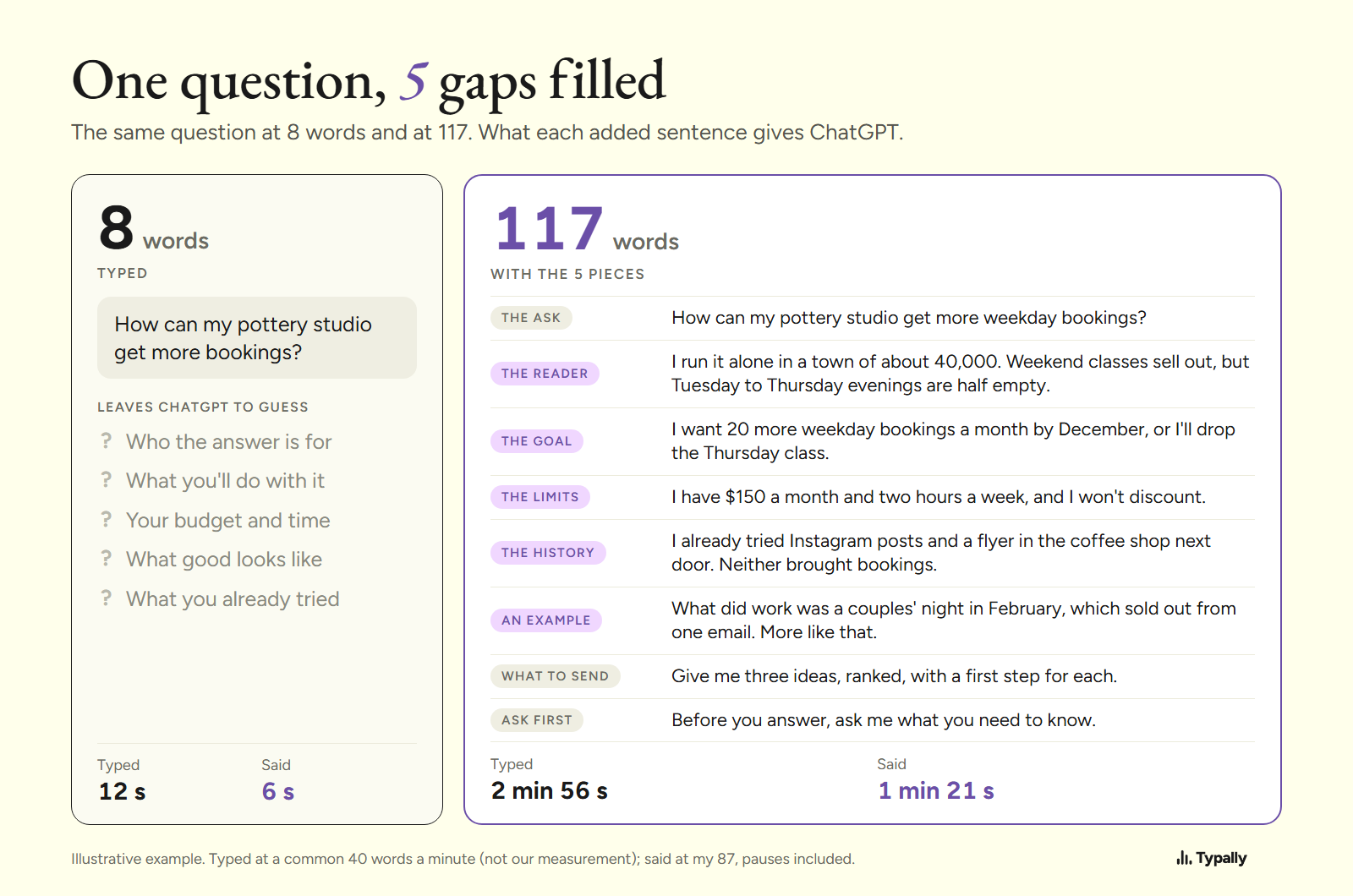
Typed (8 words)
How can my pottery studio get more bookings?
Nothing in those 8 words separates this studio from any other. Unless ChatGPT has stored facts about you, nothing in the answer can either.
With the 5 pieces (117 words)
How can my pottery studio get more weekday bookings? I run it alone in a town of about 40,000. Weekend classes sell out, but Tuesday to Thursday evenings are half empty. I want 20 more weekday bookings a month by December, or I'll drop the Thursday class. I have $150 a month and two hours a week, and I won't discount. I already tried Instagram posts and a flyer in the coffee shop next door. Neither brought bookings. What did work was a couples' night in February, which sold out from one email. More like that. Give me three ideas, ranked, with a first step for each. Before you answer, ask me what you need to know.
Which fixes go beyond adding context?
- Ask it to ask first. End with "Before you answer, ask me what you need to know." The default leans toward answering, so you have to request the questions. OpenAI's sample Project instruction ends the same way: "Ask clarifying questions." Answer them all in one message.
- Show one example. Paste an email or post you liked and say "like this". OpenAI's developer guide says a model "picks up" the pattern from examples in the prompt.
- Say what to avoid. Name the advice and phrases you don't want: "No discounts. Skip anything about posting more often."
- Store what stays true. As of October 2026, OpenAI's help pages say custom instructions "are applied immediately to all chats", and a Project's instructions "apply only within that project". Put your job, readers and banned phrases there once. How to Give ChatGPT More Context walks through both.
What should you do when the answer still misses?
Say what was wrong, once or twice. OpenAI's prompting page for ChatGPT calls this iterative refinement: "review the response, and refine the prompt based on the output." For example: "Too formal. These are regulars, not strangers."
A rule of thumb: if two rounds don't fix it, stop patching. In May 2025, researchers at Microsoft and Salesforce ran more than 200,000 simulated conversations on 15 models, GPT-4o among them. When a task's details arrived one turn at a time, performance fell by 39% on average.
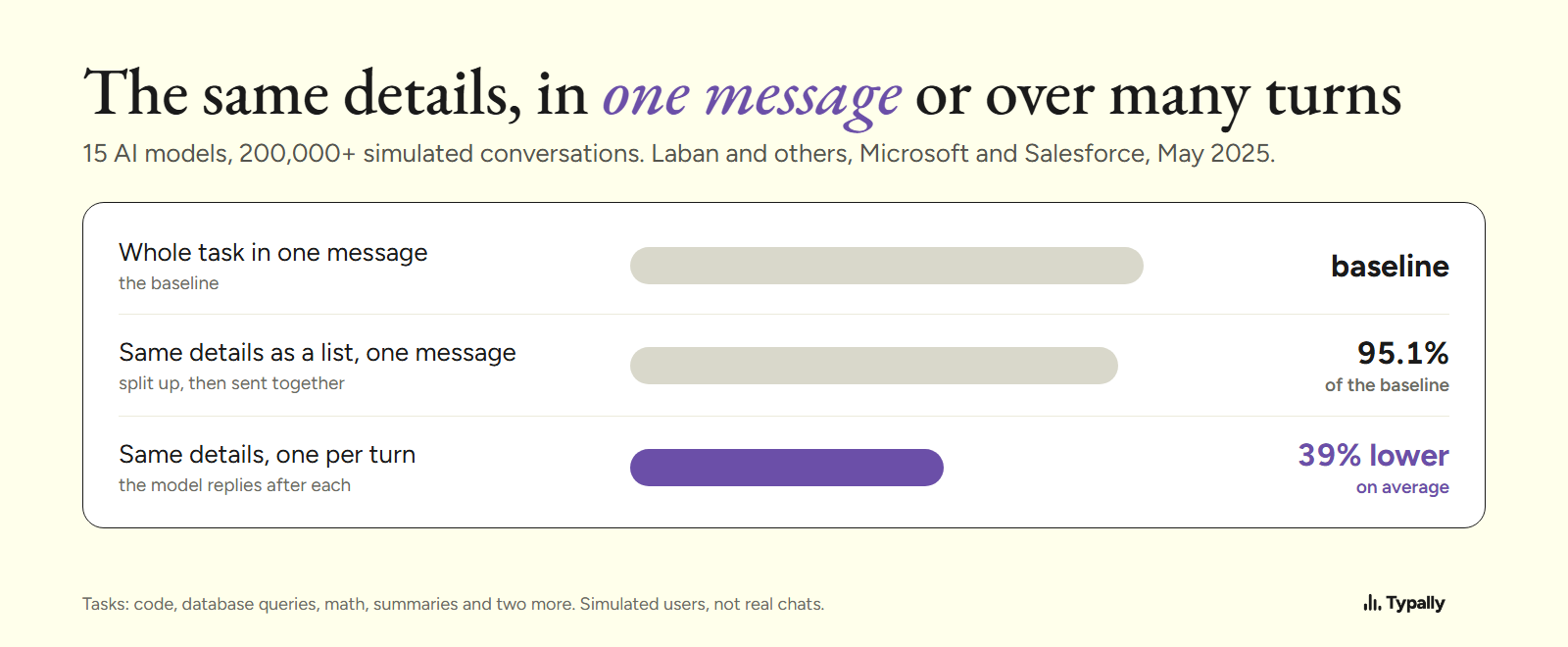
The authors' reading: "LLMs often make assumptions in early turns and prematurely attempt to generate final solutions, on which they overly rely." The users were simulated, on tasks such as code, math and summaries, so treat 39% as a direction.
Their advice: ask the model to "consolidate everything I've told you so far", then paste the result into a new chat.
Is saying the missing pieces quicker than typing them?
By the numbers I have, yes. At a commonly cited 40 words a minute (not my measurement), the 117-word prompt takes 2 minutes 56 seconds to type.
By September 30, 2026, I had dictated 476,777 words in 91 hours 31 minutes. That's about 87 words a minute with every pause counted. At that pace the 117 words take 1 minute 21 seconds. The 5 pieces alone are 87 words: one minute.
I haven't measured whether my answers got better. My claim is smaller: a piece that takes 10 to 15 seconds to say is harder to skip. Is Speaking Faster Than Typing? has the speed numbers, and Voice Prompting has the order I say a prompt in.
Three ways to dictate are free, as of October 2026. ChatGPT's dictation button works only inside ChatGPT. Windows voice typing (Win+H) covers most text boxes and leaves the ums in. macOS Dictation types your restarts too. For one missing sentence inside ChatGPT, its own button may be all you need.
Where does Typally fit?
Typally, voice typing for Mac and Windows, is what I use for my prompts. Hold your shortcut key, say the missing pieces, let go, and clean text appears where your cursor is. That can be ChatGPT, Claude, Gemini, Perplexity or any other text box. It records for as long as you hold the key, removes the ums and fixes the punctuation.
It listens only while you hold the key. The audio is discarded after transcription, and your history stays on your computer.
Next time an answer could be anyone's, find the missing piece and say it. Download Typally free at typally.com for Windows or Mac. The free plan gives you 100 minutes a month and doesn't ask for a card.
What else do people ask about generic ChatGPT answers?
Does a longer prompt always fix a generic answer?
No: length helps only when it adds a missing piece. In the Carnegie Mellon study, models followed a requirement stated alone 98.7% of the time, and GPT-4o averaged 85.0% with 19 in one prompt. How Long Should a ChatGPT Prompt Be? covers what to cut.
Do Claude and Gemini give generic answers too?
The cause is the same. All 15 models in that study did worse when details came turn by turn, Claude and Gemini models included. Anthropic's prompting guide says to think of Claude as "a brilliant but new employee who lacks context on your norms and workflows".
Is Typally free?
There's a free plan with 100 minutes of dictation a month, forever, and it doesn't ask for a card. Pro has a 14-day free trial, and the trial needs a card.