To write a prompt for AI, state the task, then add what the assistant can't know about you and your reader. A full prompt has up to 7 parts, and they work the same in ChatGPT, Claude, Gemini and Copilot.
In short:
- A prompt has up to 7 parts: the task, the reader, the facts only you know, the limits, an example, what you already tried, and what to send back.
- OpenAI, Anthropic, Google and Microsoft each publish a prompting page. Read on October 8, 2026, all four name nearly the same short list.
- When two corrections don't fix an answer, start a new chat with a better first prompt. Anthropic's Claude Code guide gives the same rule.
I build Typally, and it comes up near the end. It began as a tool for our own Claude Code prompts. The ones that worked were long and carried four things: the bug, the files, what we'd tried, what not to touch.
This guide covers text prompts for chat assistants. Image, video and music prompts are a different skill and aren't covered.
What does a good prompt for AI need?
It needs the task, plus up to 6 things the assistant would otherwise guess.
- The task: what it should do.
- The reader: who the result is for.
- The facts only you know: names, numbers, what already happened.
- The limits: length, tone, what must stay out.
- An example: one piece you liked, pasted in.
- What you already tried: the draft or fix that failed, and how.
- What to send back: how many versions, in what format.
To pick the facts, use the test in How to Give ChatGPT More Context: would the answer change if this fact were different?
Our four things fit the list. The bug is the task. The files are facts only we knew. What we'd tried is part 6, and what not to touch is a limit.
What do OpenAI, Anthropic, Google and Microsoft say a prompt needs?
Nearly the same short list, as of October 8, 2026: a clear task, context, and the shape of the answer.
- OpenAI. Its help page says models "often perform best when interacted with as if you are sending another human a request". Its checklist: "always identify the task clearly, provide necessary context, and set the preferred tone and style".
- Anthropic. Its prompting guide says to show your prompt to a colleague who lacks the context: "If they'd be confused, Claude will be too."
- Google. Its Gemini help page on Gems says good instructions and good prompts share four areas: persona, task, context and format. It adds: "You don't need to use all four, but using a few will help".
- Microsoft. Its Copilot page, last updated September 2026, names four parts: goal, context, source and expectations.
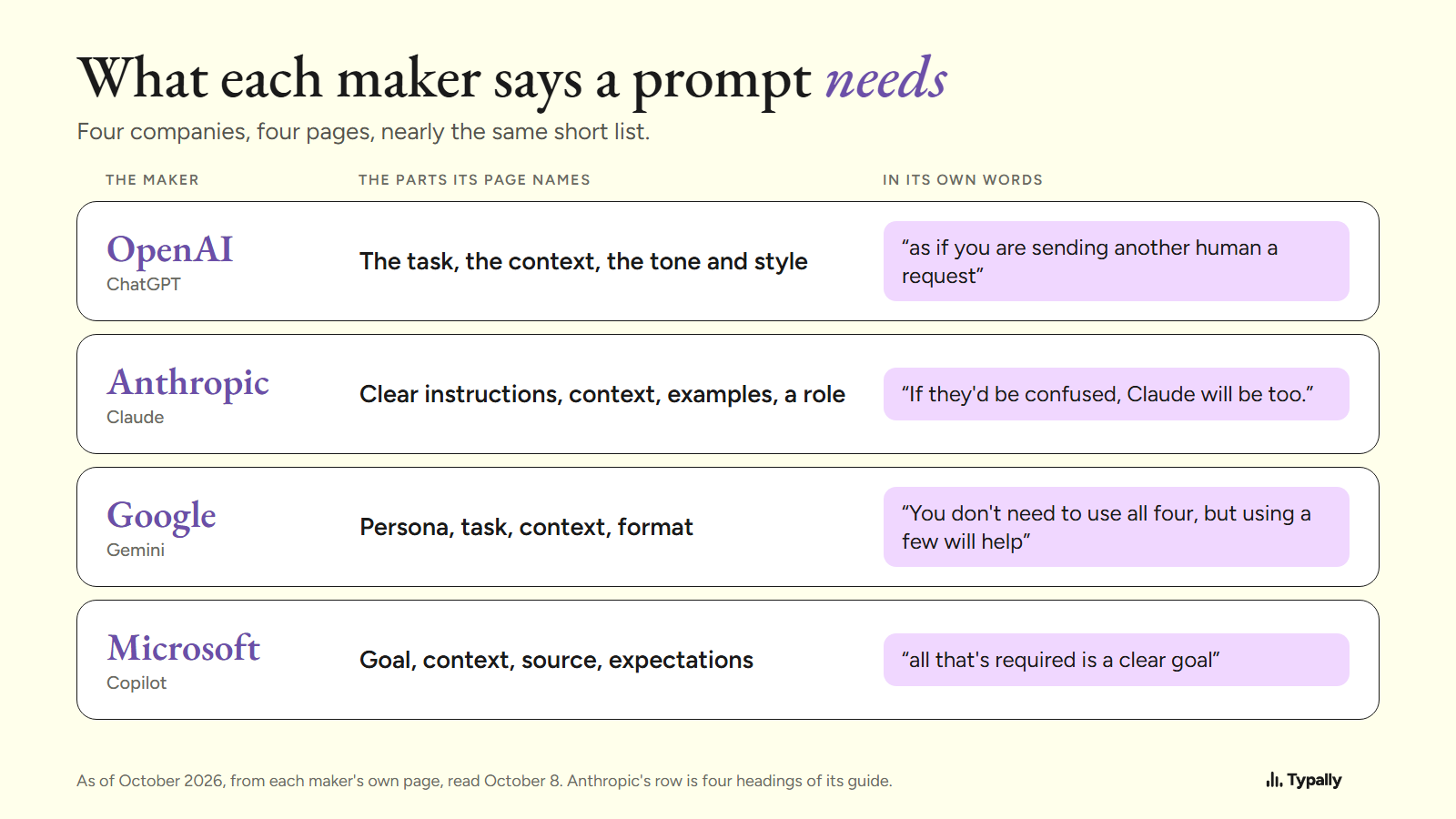
None of these pages has a line for what you already tried. That part comes from our own prompts.
What does an example prompt look like, built part by part?
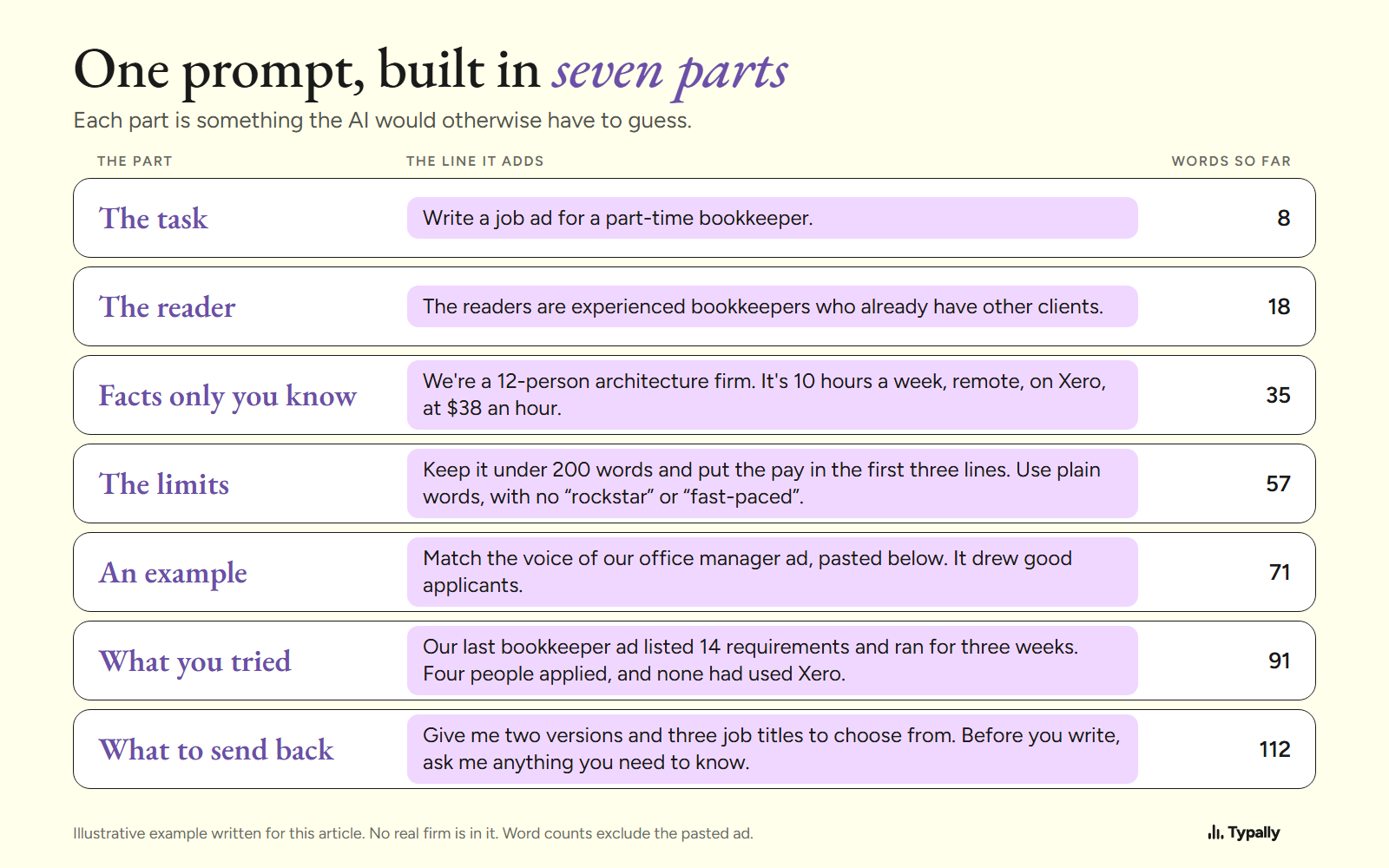
It starts at 8 words and ends at 112. The example is illustrative; no real firm is in it.
- The task (8 words). "Write a job ad for a part-time bookkeeper."
- The reader (18). "The readers are experienced bookkeepers who already have other clients."
- The facts (35). "We're a 12-person architecture firm. It's 10 hours a week, remote, on Xero, at $38 an hour."
- The limits (57). "Keep it under 200 words and put the pay in the first three lines. Use plain words, with no 'rockstar' or 'fast-paced'."
- An example (71). "Match the voice of our office manager ad, pasted below. It drew good applicants."
- What you tried (91). "Our last bookkeeper ad listed 14 requirements and ran for three weeks. Four people applied, and none had used Xero."
- What to send back (112). "Give me two versions and three job titles to choose from. Before you write, ask me anything you need to know."
Line 6 tells the assistant which ad not to write again. How Long Should a ChatGPT Prompt Be? shows another task at 12, 60 and 250 words.
Which mistakes do the makers warn about?
Three come up, and three of the four makers agree on the first.
- Saying only what not to do. OpenAI's API tips: "Instead of just saying what not to do, say what to do instead". Microsoft's prompting tips and Anthropic's guide agree. So pair each ban with what to do instead.
- Several jobs in one prompt. Google's Workspace tips: for related tasks, "break them apart into separate prompts."
- Ignoring the order. Here the makers differ. OpenAI puts instructions at the beginning. Microsoft says "Later parts of a prompt are likely to be emphasized more than earlier parts." Anthropic puts long documents at the top and the question at the end. In a long prompt, try both orders.
When should you refine an answer, and when should you start over?
Refine first: say what was wrong, once or twice. Microsoft's tips say "Often the first result isn't the final or best response."
Start over when corrections stop working. Anthropic wrote this rule for Claude Code, its coding tool: "A clean session with a better prompt almost always outperforms a long session with accumulated corrections." Its trigger is two failed corrections.
Before you leave the old chat, move what you learned into part 6 of the new prompt. Why Does ChatGPT Give Generic Answers? shows how to spot the missing part, and has a study of details sent turn by turn.
Is it quicker to say a long prompt than to type it?
By the numbers I have, yes. At a commonly cited 40 words a minute (an average, not my measurement), the 112-word prompt takes 2 minutes 48 seconds to type.
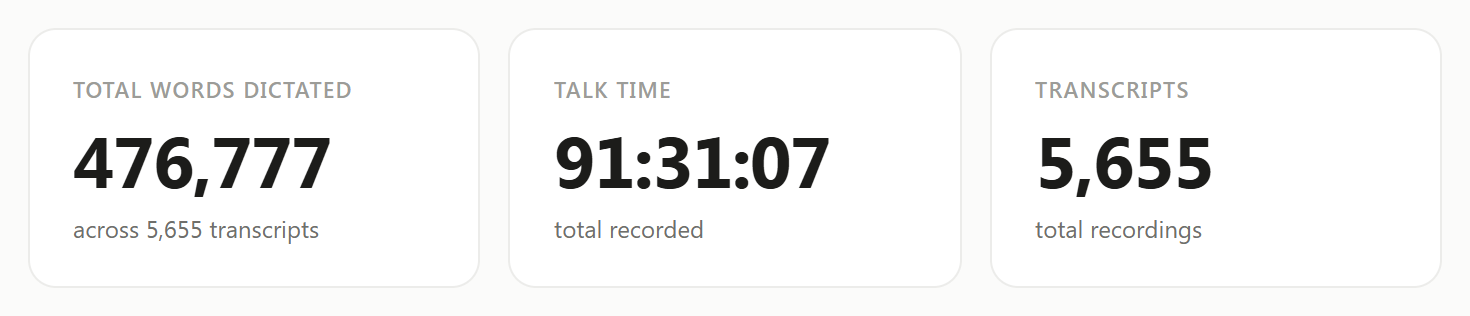
I use Typally purely for prompting Claude, ChatGPT and other AI. On September 30, 2026, my Insights screen showed 476,777 words across 5,655 dictations, about 84 words each. That's about 87 words a minute with every pause counted. At that pace the 112 words take 1 minute 17 seconds.
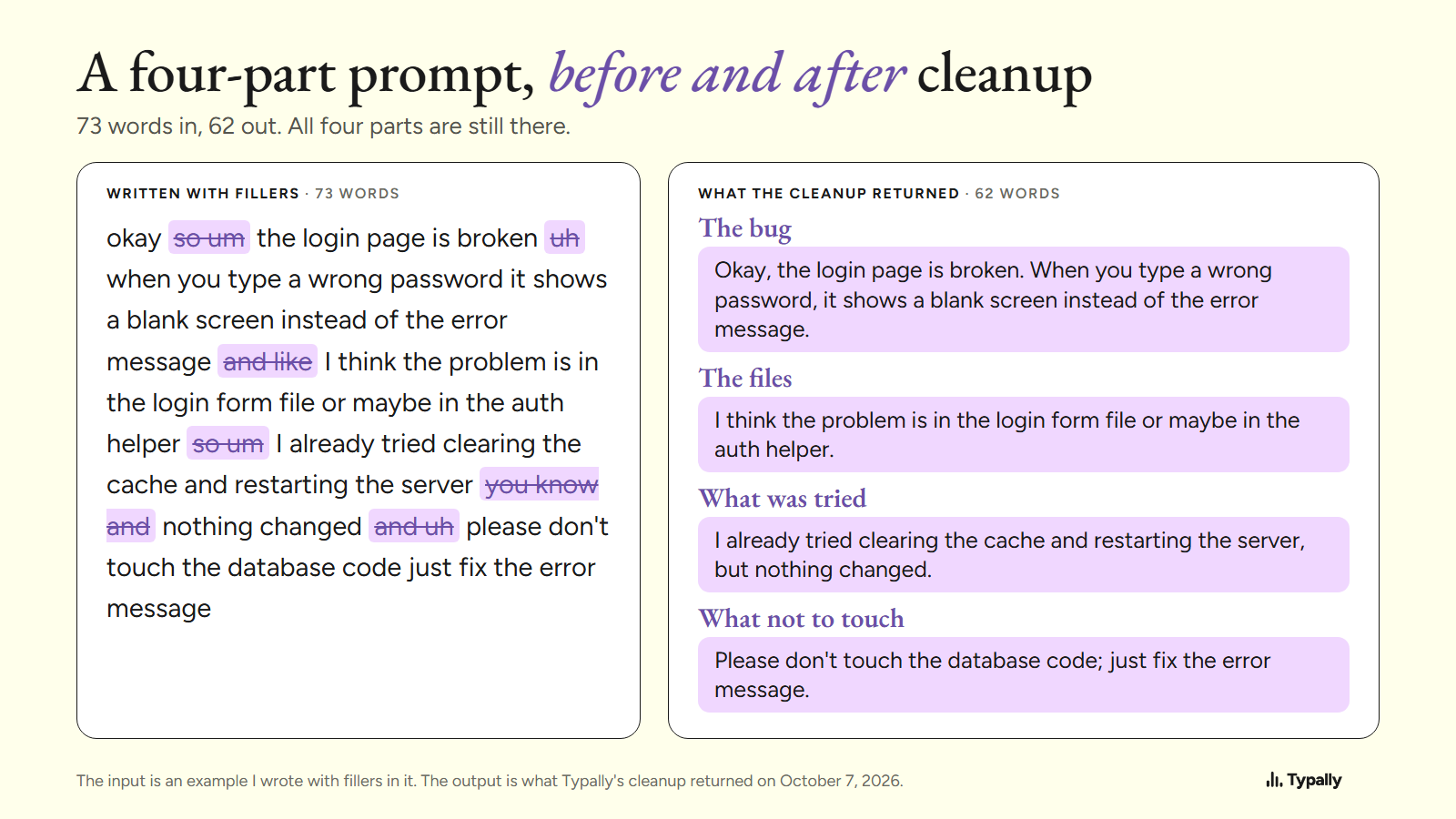
Said aloud, a prompt comes with ums. I wrote an example with our four parts and with fillers, then ran Typally's cleanup on it on October 7, 2026. It went in at 73 words and came back at 62. The um, uh, like and you know were gone, and one "and" became "but".
I haven't measured whether my answers got better. Voice Prompting covers the four parts of a prompt you say.
Built-in ways exist, as of October 2026. ChatGPT has a microphone icon, and Claude's app has a mic; Talk to Claude covers it. Windows voice typing and Mac Dictation type into other apps too. If you prompt inside one app, its own mic may be all you need.
Where does Typally fit?
Typally, voice typing for Mac and Windows, is the app I build. Hold your shortcut key, say the prompt, let go, and the text appears where your cursor is. That can be ChatGPT, Claude, Gemini or Claude Code. The cleanup is on by default: it removes the ums and fixes the punctuation and capitals.
It listens only while you hold the key. The audio is discarded after transcription, and your transcripts and history stay on your computer. It needs an internet connection.
Download Typally free at typally.com for Windows or Mac. The free plan gives you 100 minutes a month and doesn't ask for a card.
What else do people ask about writing prompts?
Is a prompt for ChatGPT different from a prompt for Claude?
The parts are the same: both makers' pages ask for a clear task and context. Anthropic's guide adds advice for Claude alone, such as XML tags around the parts of a long prompt.
How long should a prompt for AI be?
Long enough to hold the parts that would change the answer. Microsoft's page says: "You can put a little or a lot into a prompt, but all that's required is a clear goal."
Is Typally free?
There's a free plan with 100 minutes of dictation a month, forever, and it doesn't ask for a card. Pro has a 14-day free trial, and the trial needs a card.