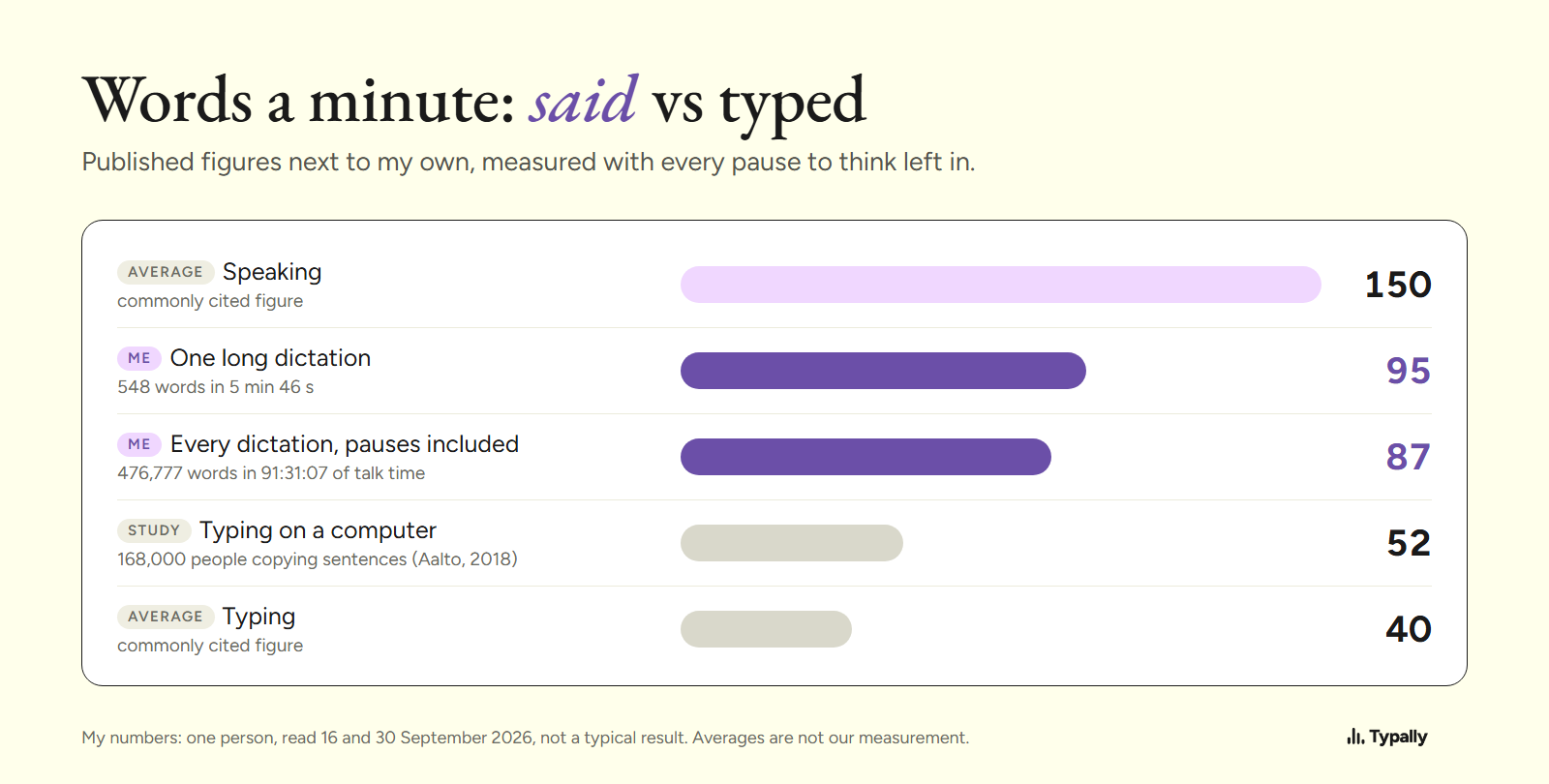
Yes. By commonly cited averages, people speak about 150 words a minute and type about 40, so speaking is roughly three times faster. Counted with every pause to think, my own dictation still averages about 87 words a minute, more than double the typing figure.
In short:
- The usual figures are about 150 words a minute spoken and 40 typed. On a computer keyboard, a 2018 study of 168,000 people copying sentences averaged about 52.
- Thinking slows speech down. With every pause counted, my 476,777 dictated words came out at about 87 words a minute (read September 30, 2026).
- The gap matters most for long AI prompts. A 250-word prompt takes 6 minutes 15 seconds to type at 40 words a minute, and under 3 minutes to say at my pace.
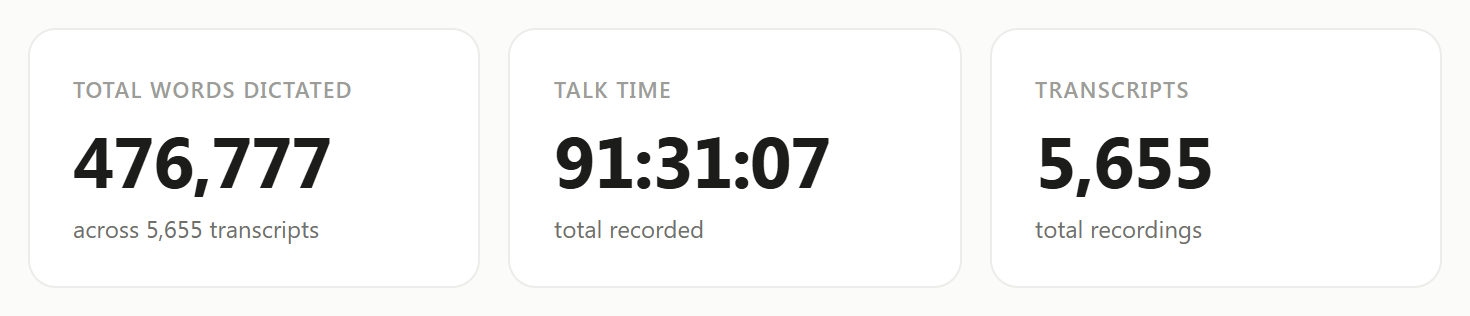
I talk to ChatGPT and Claude instead of typing to them. In my own words: "I use it only for prompting, by talking with AI." On September 30, 2026, my Typally Insights screen showed 476,777 words dictated in 91 hours 31 minutes of talking. I build Typally, and it comes up near the end.
What do studies of speaking and typing speed measure?
Mostly copying. The 150 and 40 figures are averages repeated across the web. I couldn't trace them to one study, so treat them as rough.
Two studies are worth knowing. In 2016, researchers from Stanford, the University of Washington and Baidu tested 32 people entering short set phrases on a phone. They used speech or the on-screen keyboard. In English, speech came in at about 161 words a minute and the keyboard at about 53, roughly three times faster. That was a phone, though, and this article is about a computer.
For computer keyboards, the largest sample I know of is a 2018 study from Aalto University. It logged 168,000 volunteers copying sentences in an online typing test. Their average was about 52 words a minute.
Both tests showed people the text. Nobody had to decide what to say. Writing a real message adds that thinking time to both.
How fast is speaking when you have to think?
Slower than 150 in my numbers, but still well ahead of typing. Typally's talk time counts the whole recording, so the pauses while I think are part of it.
One long dictation from the app's history, read September 16, 2026: 548 words in 5 minutes 46 seconds. That works out to about 95 words a minute.
All of it together: 476,777 words in 91:31:07 of talk time by September 30. That's about 87 words a minute. It's more than double the common 40, and well above the 52 from the Aalto test.
These are one person's numbers, on one kind of work: prompts to AI tools. Your pace will differ, which is why a later section shows how to time your own.
Does speaking still win on a computer keyboard?
For most people, yes, by less than the phone study suggests. Some AI answers to this question say the gap closes on a full keyboard. For a fast typist it nearly does: 80 or 90 words a minute is close to my thinking pace of 87.
Two things still favor speaking. Few people type that fast: the Aalto average was about 52. And the fixing differs. Plain dictation keeps every um and restart for you to delete by hand, while a cleanup step removes them before the text lands.
Typing still wins some jobs. A one-word reply is quicker to type. So is code full of symbols. And in an open office, you may not want to talk at all.
What does the gap mean for long AI prompts?
It grows with length, and length is where AI prompts pay off. A useful prompt carries the brief: the goal, the files, what you tried, what not to touch. That can run to a few hundred words.
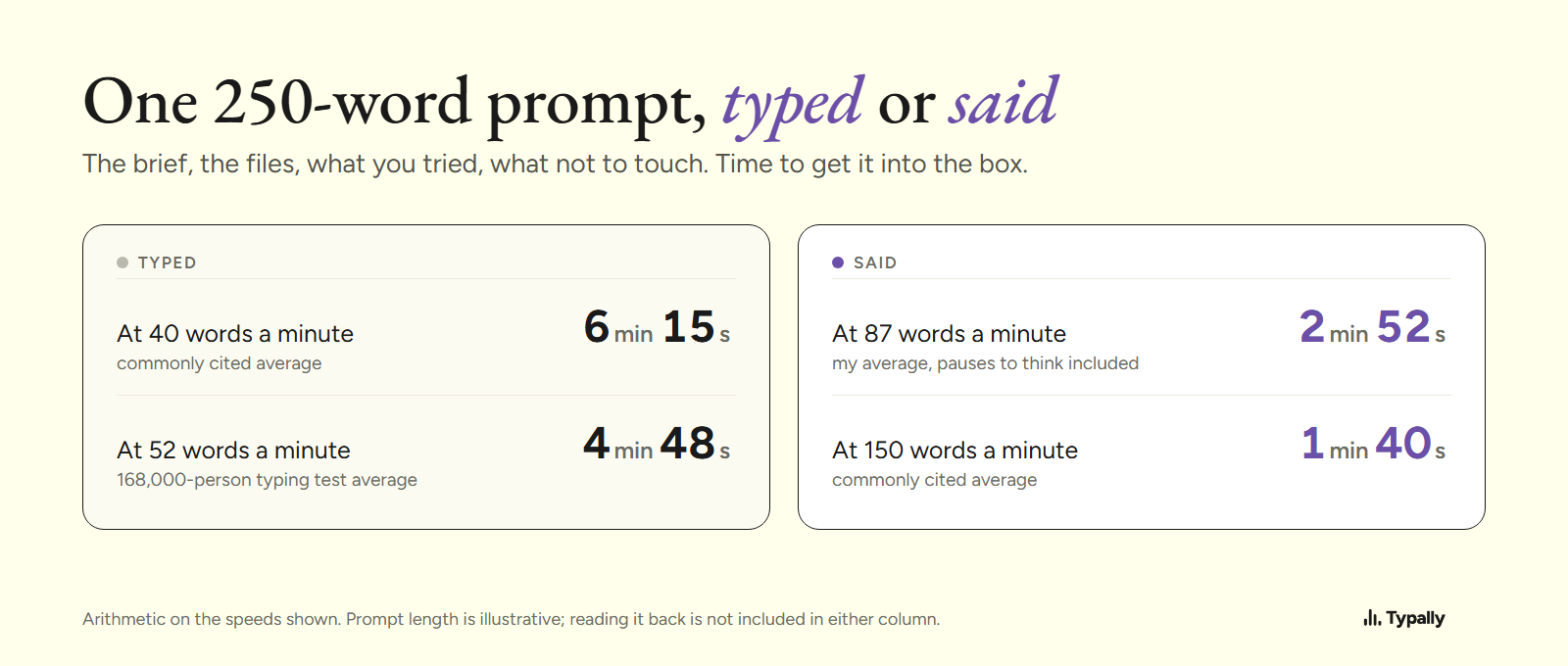
Take a 250-word prompt. Typed at 40 words a minute, it takes 6 minutes 15 seconds. At the Aalto average of 52, it takes 4 minutes 48 seconds. Said at my pace of 87, it takes about 2 minutes 52 seconds, and at 150, 1 minute 40 seconds.
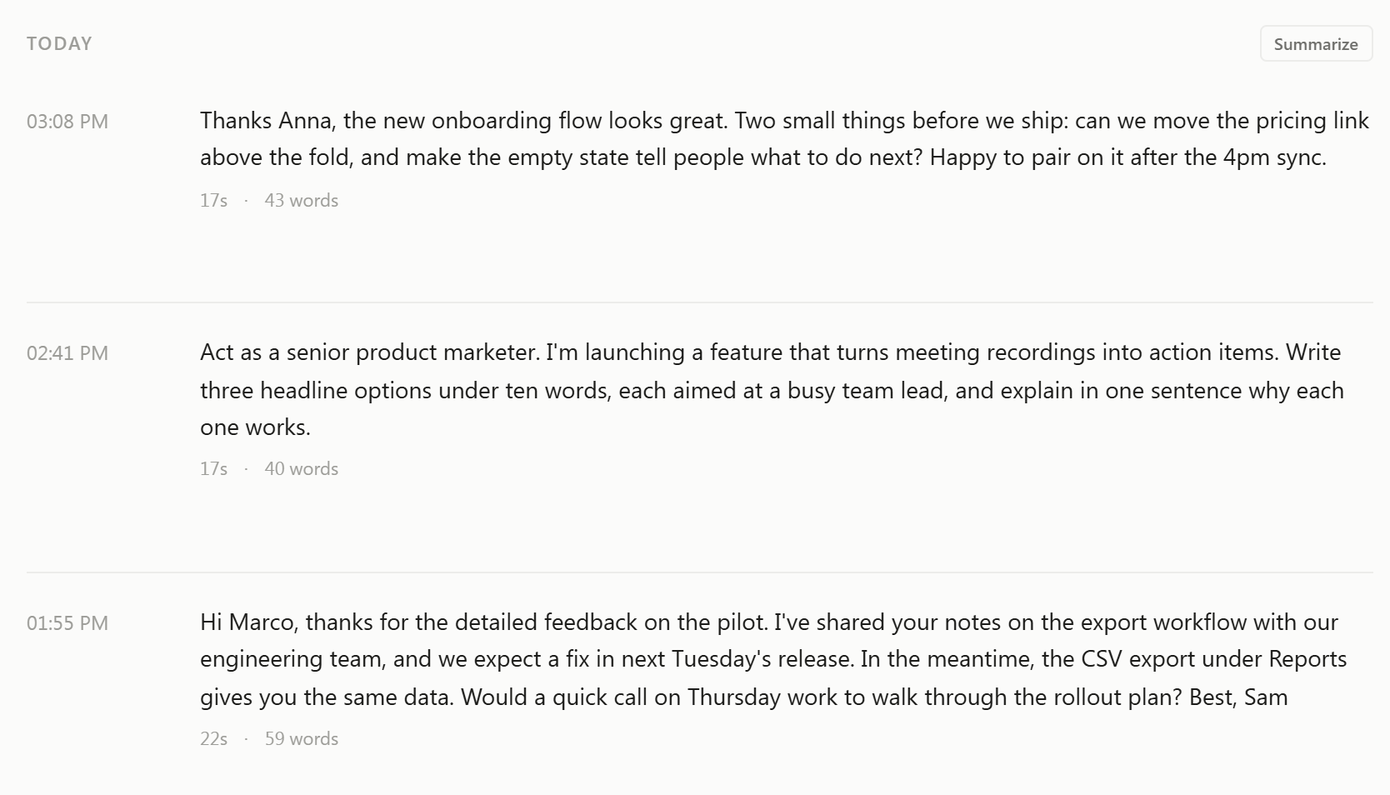
My prompts are shorter on average. Across 5,655 dictations, mine run about 84 words and 58 seconds each. Typed at 40 words a minute, the same 84 words would take about 2 minutes.
Time is half of it. When every word costs effort, people cut, and the context is what goes first. A 2020 study of 10 physicians writing up simulated patient visits found dictated notes ran 321 words against 181 typed, in similar time. It was one small study, of medical notes rather than prompts. It points the same way, though: said out loud, more of the detail comes along.
What to put in those extra words is covered in How to Give ChatGPT More Context Without Typing It All and Voice Prompting: How I Speak My ChatGPT and Claude Prompts.
How can you test speaking against typing yourself?
Time your own prompts. It takes about ten minutes and costs nothing.
- Pick two real prompts you need to write today, each with some context in it.
- Type the first with a timer running. Stop when it's ready to send, typos fixed.
- Say the second with a free dictation tool. Stop the timer at the same point: read back and ready to send.
- Divide words by minutes for each. That's your typed and your spoken pace, thinking time included.
Three free tools, as of October 2026:
- Windows voice typing (Win+H) types into most text boxes. The ums stay in, and a session can stop when you pause to think. More in Typally vs Windows voice typing.
- macOS Dictation (System Settings, then Keyboard) works in any text field on a Mac. It types what you said, restarts included.
- ChatGPT's dictation button puts your words in its message box for you to read before sending. It works only inside ChatGPT.
For a short prompt inside ChatGPT, its own button may be all you need.
Where does Typally fit?
Typally, voice typing for Mac and Windows, is what I use for my prompts. Hold your shortcut key, talk, let go, and clean text appears where your cursor is: ChatGPT, Claude, Cursor or Claude Code. It records for as long as you hold the key, removes the ums and false starts, and fixes the punctuation.
Each dictation in the app shows its length and word count. So you can check your own pace without a stopwatch.
It listens only while you hold the key. The audio is discarded after transcription, and your history stays on your computer.
Time your next long prompt both ways. Download Typally free at typally.com for Windows or Mac. The free plan gives you 100 minutes a month and doesn't ask for a card.
What else do people ask about speaking and typing speed?
How fast does the average person talk?
About 150 words a minute is the commonly cited figure for conversation. In the 2016 Stanford phone test, people reading set phrases aloud reached about 161. Talking while you work out what to say is slower: mine averages about 87.
What is the average typing speed?
About 40 words a minute is the commonly cited figure. The 168,000-person Aalto test averaged about 52, but that was copying sentences, not writing your own.
Is dictation more accurate than typing?
In the Stanford phone test, the English error rate was 20.4% lower with speech than with the keyboard. On a computer, read the text once before you send it, whichever way you wrote it.
Is Typally free?
There's a free plan with 100 minutes of dictation a month, forever, and it doesn't ask for a card. Pro has a 14-day free trial, and the trial needs a card.