An AI English tutor is software that reads or hears your English and answers with corrections, explanations or practice. Four kinds exist, and each does a different job.
In short:
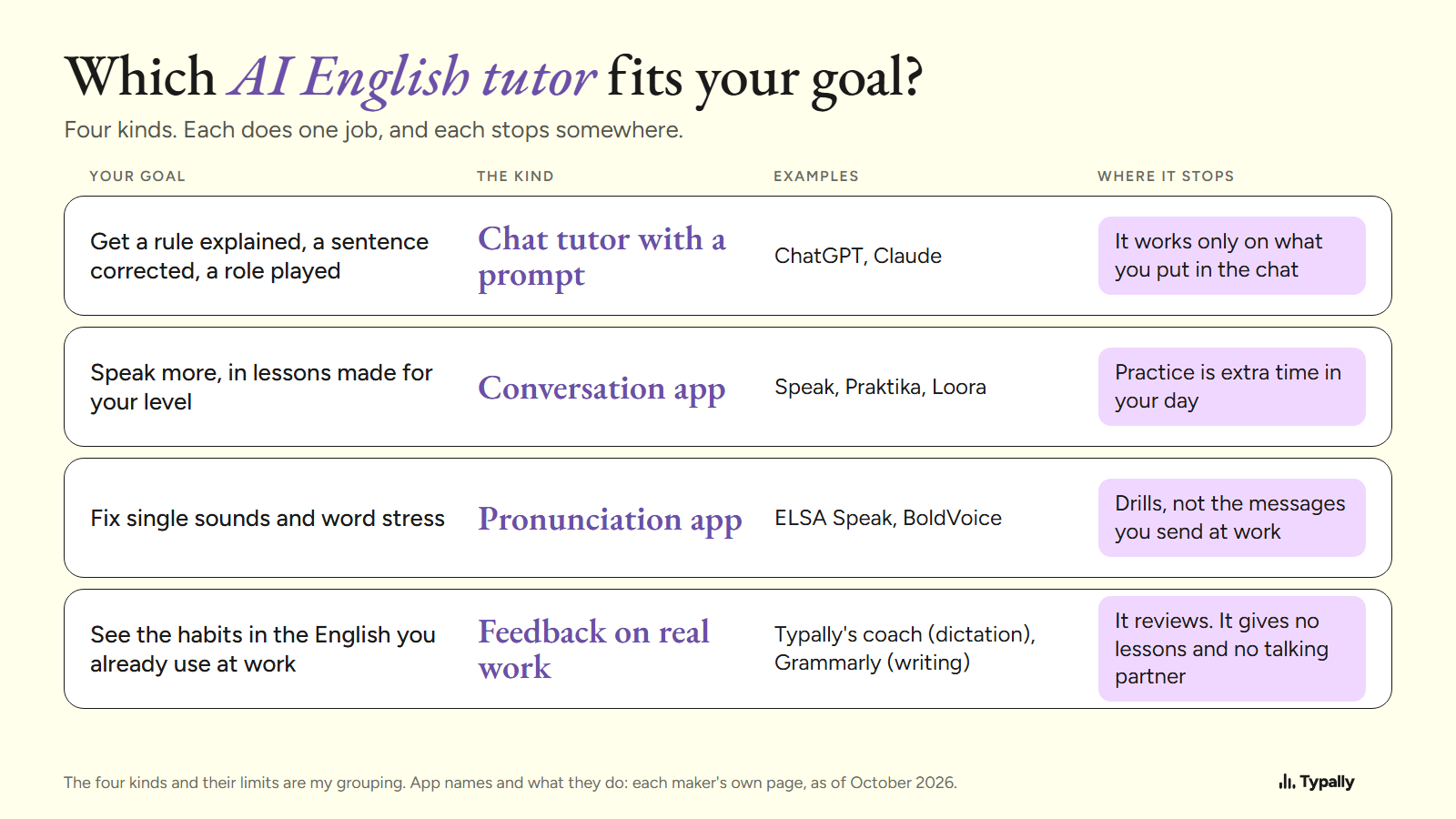
- The 4 kinds are a chat tutor (ChatGPT or Claude with a prompt), conversation apps, pronunciation apps, and feedback on your real work English.
- An AI tutor can explain a rule, correct a sentence and play a role at any hour. It can also be wrong, and it only knows the English you give it.
- Pick by goal. For rules and corrections, a chat tutor. For speaking time, a conversation app. For single sounds, a pronunciation app. For work habits, feedback on your real messages.
I build Typally, and its speech coach is one of the 4 kinds. It comes up near the end. Every fact about another app here comes from its maker's own page, read on October 6, 2026. I did not try those apps.
What kinds of AI English tutor are there?
There are 4, and they differ in what they read or hear.
A chat tutor with a prompt
ChatGPT and Claude are general assistants. They act as a tutor when your prompt says how. OpenAI's ChatGPT Voice page lists "practice languages" among its uses. Its study mode page describes "step-by-step guidance instead of quick answers". Anthropic's help page calls Claude's voice mode "a beta feature available to all plans".
Conversation apps
These are built for speaking practice with an AI partner. Speak lists English among its 7 languages, and you apply each lesson in a "real back-and-forth conversation with the Speak Tutor AI". Praktika says you get "instant, gentle corrections on pronunciation, grammar, and word choice". Loora calls itself "Your Personal AI English Tutor". All 3 pages send you to a phone app download.
Duolingo Max adds Video Call and Roleplay. The Duolingo post I read lists both for English speakers learning other languages, so check your own course before you pay.
Pronunciation apps
These score how you say single sounds and words. BoldVoice says it "instantly analyzes your pronunciation, stress and clarity". ELSA Speak is another. Our guide to English pronunciation apps covers 10 of them, so I'll stop here.
Feedback on the English you already use at work
This kind adds no practice session. It looks at what you produce anyway. Grammarly checks your writing. ELSA's Speech Analyzer gives feedback on recorded speech: "pronunciation, fluency, intonation, and vocabulary". Typally's speech coach reads what you dictate.
What can an AI English tutor do?
It can explain, correct and practice with you at any hour, as many times as you ask.
- Explain a rule. OpenAI's study mode page lists "questions, hints, and step-by-step explanations".
- Correct a sentence. Praktika's home page shows a learner's line, "I'm bad to speak English". The tutor answers: "Do you mean «I'm bad at speaking English»?"
- Play a role. Loora lists practice "for interviews, meetings, and professional presentations". One of OpenAI's sample voice requests is "Give me feedback on my elevator pitch for my startup."
- Remember. In study mode, OpenAI says, ChatGPT "gauges your level and remembers past sessions".
What can't an AI English tutor do?
It can't be right every time, and it can't hear the English you use outside the app. The points below are my reading of the makers' pages, not test results.
- It can be wrong. Anthropic's help page says "Claude can occasionally produce responses that are incorrect or misleading." Duolingo writes that "technology is never perfect". When a correction surprises you, check it in a dictionary or with a colleague.
- It knows only what you give it. A conversation app hears the practice session. It doesn't hear Tuesday's client call or read the update you sent your manager.
- It can't promise a result. I can't either. My own numbers are near the end, and they are one person's.
My view: a human teacher is still the better pick when you need someone who expects you every week.
How do you use ChatGPT or Claude as an English tutor?
Paste a prompt that sets the role, the topic and how to correct you. This one is an example I wrote. I have not measured what it does for anyone's English.
Be my English tutor for the next 15 minutes. I work in customer support, and I write emails and chat replies in English. Ask me about my work, one question at a time. After each answer, do three things. First, quote up to two of my sentences that have a mistake and show the corrected version. Second, give the rule in one short sentence. Third, ask the next question. Do not rewrite my whole answer. If a sentence is correct but there is a more common way to say it, show that and mark it as optional. When I write "stop", list the three mistakes I made most often, each with my own sentence.
Change the second sentence to your job. The limit of two corrections is my choice, to keep each reply short. To say your answers aloud, see Talk to ChatGPT.
Which AI English tutors are free?
Both chat tutors have a free plan, and so does Grammarly, as of October 2026. For most people that is the fair first try.
- ChatGPT. OpenAI's pricing page lists study mode on the Free plan, with "Limited voice chats".
- Claude. Voice mode is on the Free plan too. Anthropic notes that voice conversations "count toward your regular usage limits".
- Grammarly. Its page sums up the Free plan as "Write without spelling and grammar mistakes."
- Conversation apps. Speak has "a 7-day free trial, after which a paid subscription is required". Loora offers "a trial period". Neither page prints a price. Praktika's home page shows "~$8 / month".
Where does Typally's speech coach fit?
Typally, voice typing for Mac and Windows, has a speech coach, and the coach is the fourth kind: feedback on real work. Hold your shortcut key, talk, let go, and the text appears where your cursor is. That can be ChatGPT, Claude, Gmail or Slack. The coach then reads what you dictated and gives a score out of 100.
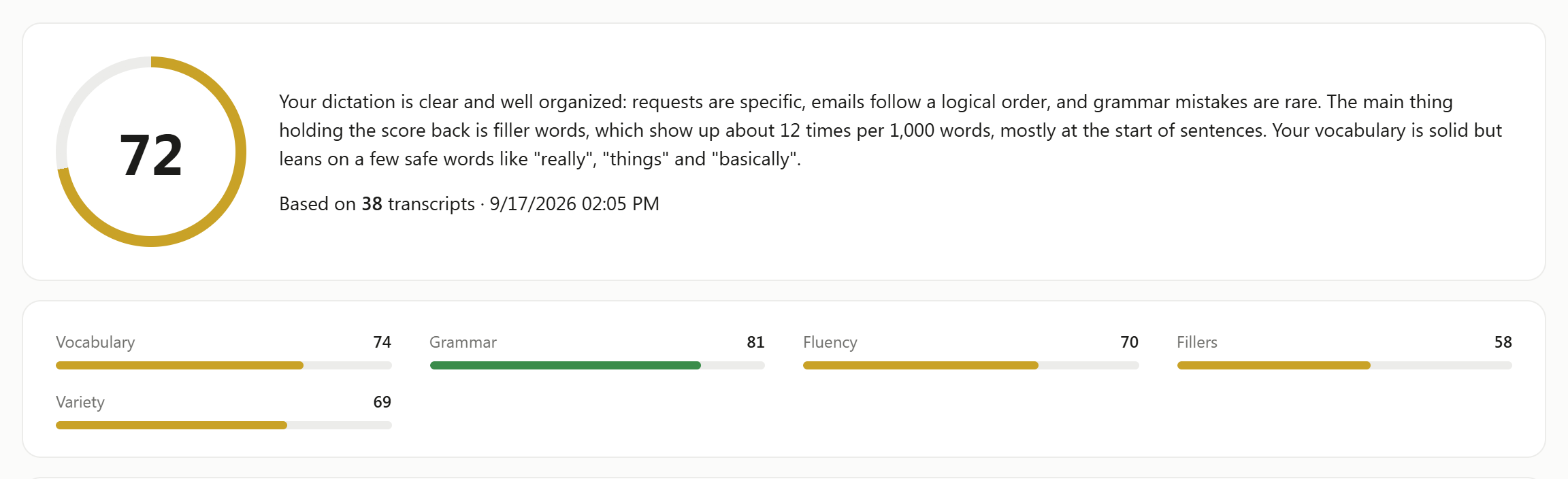
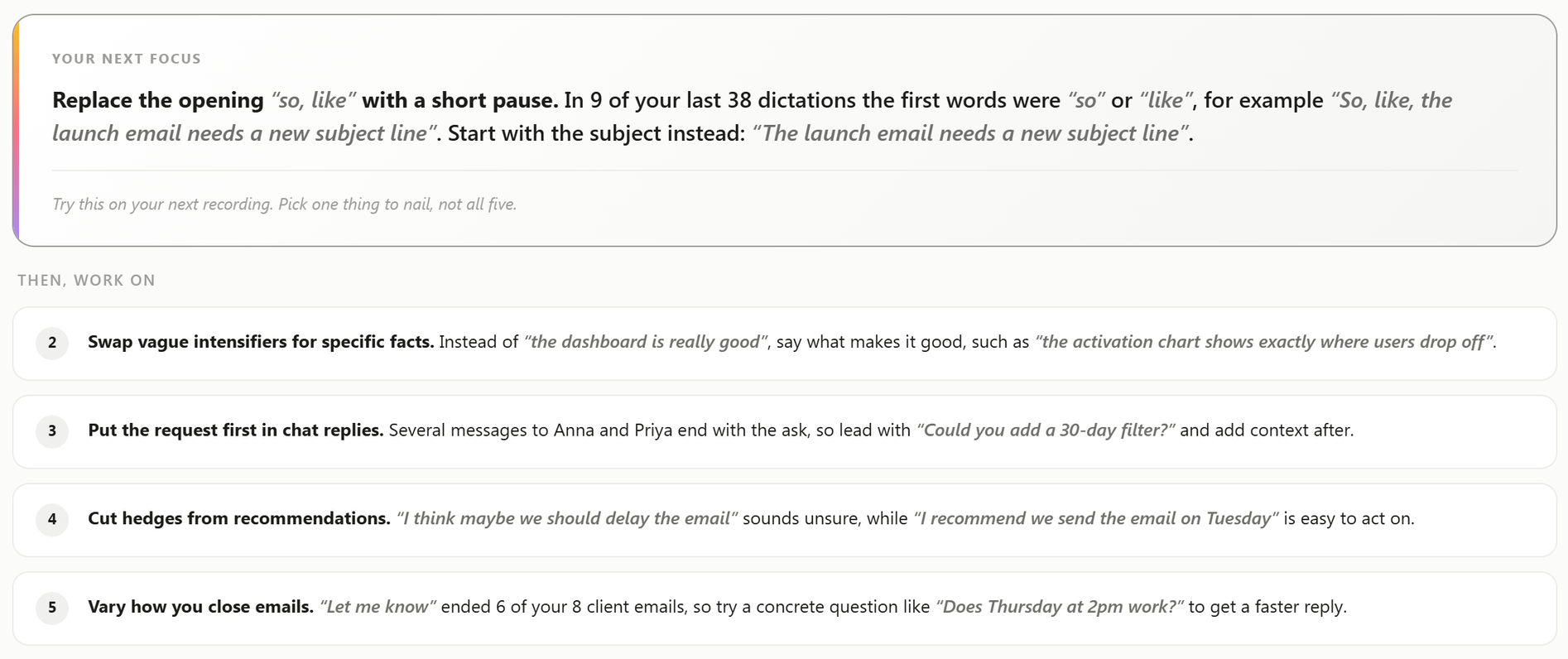
A language model gives that score from a recent sample of about 2,000 words. The app itself counts your fillers per 1,000 words. Then the coach names one "next focus", drawn from your own sentences.
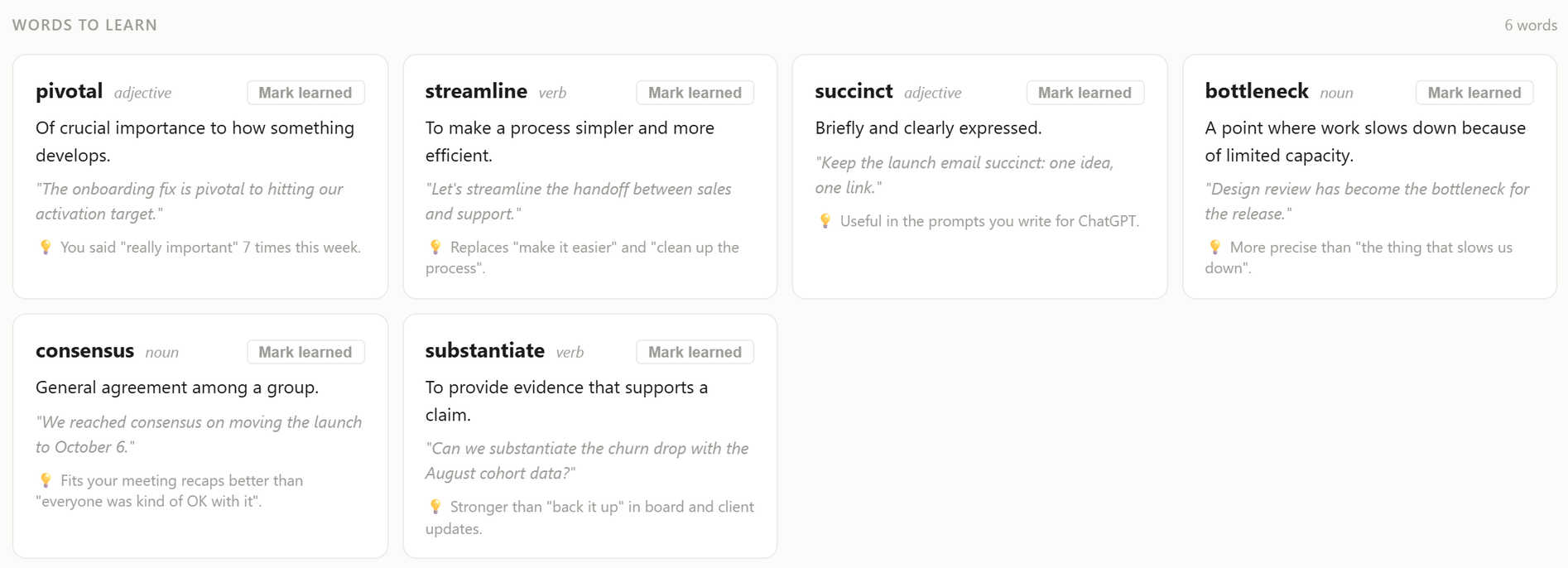
It also suggests words to learn, each with a sentence on a topic you talked about.
It is feedback only. It gives no lessons and no conversation, and it reads text, so it does not score pronunciation. For those, pick one of the other 3 kinds. English speaking practice at work and business English for work messages have their own guides.
My own coach score went from 67 on May 21, 2026 to 73 on August 13, 2026. That is one person, and I can't say what caused it. My filler rate did not fall in the two weeks I counted, July 30 to August 12, 2026. It was about 100 per 1,000 words, by the coach's list of 22 filler words and phrases.
Typally listens only while you hold the key, and the audio is discarded after transcription. Download Typally free at typally.com for Windows or Mac. The free plan gives you 100 minutes a month and doesn't ask for a card.
What else do people ask about AI English tutors?
Can ChatGPT be an AI English teacher?
Yes, when your prompt tells it to act like one. It explains rules and corrects what you send. It can be wrong, so check a correction that surprises you.
Which learn English app works on a computer?
ChatGPT and Claude both run in a browser. Grammarly lists desktop and browser versions, and Typally is a Windows and Mac app. Speak, Praktika and Loora point to phone app downloads.
Is Typally free?
There's a free plan with 100 minutes of dictation a month, forever, and it doesn't ask for a card. Pro is $11.99 a month with a 14-day free trial, and the trial needs a card.