English filler words are small words and phrases such as um, well, so, you know, I mean and kind of. Used on purpose, they buy you time, soften a point and tell the listener what comes next.
In short:
- Each filler has a job. Cambridge's grammar says well shows "that we are thinking about the question", and kind of softens words that would sound "too direct or exact".
- At work, well, so, okay, right and anyway are the low-risk ones, by my reading of Cambridge's notes. Like is the one to watch: Cambridge places it in "informal speaking".
- I'm Lithuanian and I work in English. In 41,668 words of my own dictation (July 30 to August 12, 2026), my app's coach counted about 100 fillers per 1,000 words.
Each claim below about what a filler signals links to a source I opened on October 6, 2026. I build Typally, and it comes up near the end. For definitions and the long list, see filler words.
What does each English filler word signal?
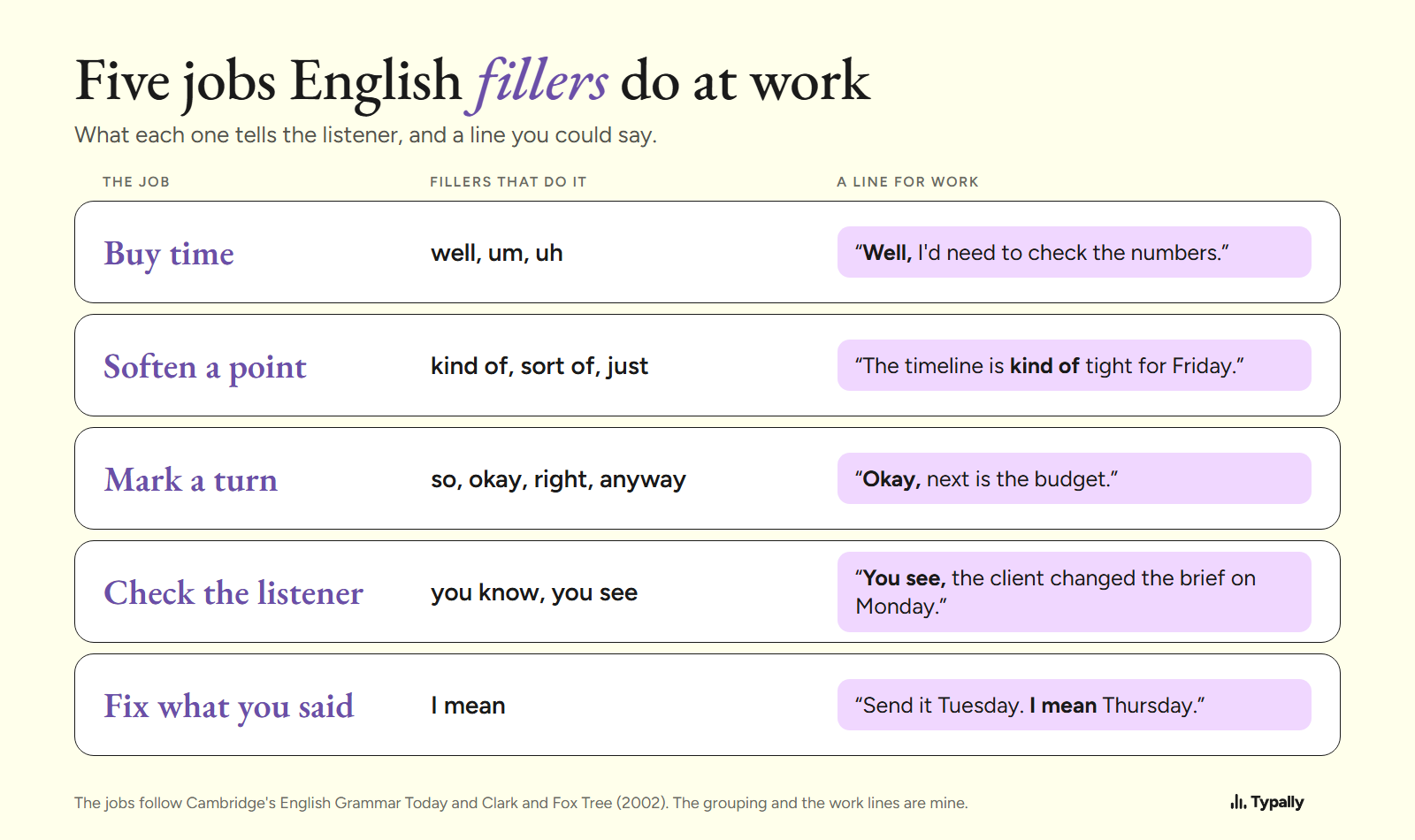
One of five things: buying time, softening, marking a turn, checking the listener, or fixing what you said. The grouping is mine, built from Cambridge's English Grammar Today. The work lines are my examples.
- Buying time. A 2002 paper by Clark and Fox Tree proposes that speakers use uh and um "to announce that they are initiating what they expect to be a minor (uh), or major (um), delay in speaking". Cambridge says the main function of well is "to show that we are thinking about the question that we have been asked". At work: "Well, I'd need to check the numbers."
- Softening. Kind of and sort of "soften other words and phrases so that they do not appear too direct or exact". Cambridge calls hedges like these "an important part of polite conversation". At work: "The timeline is kind of tight for Friday."
- Marking a turn. So comes "when we are summarising what has just been said, or when we are changing topic". Okay shows "that we are moving on to a new topic or phase of conversation". At work: "Okay, next is the budget."
- Checking the listener. You know checks "that we share the same knowledge". With you see, "we assume that the listener or listeners do not have the knowledge". At work: "You see, the client changed the brief on Monday."
- Fixing what you said. I mean is for when we want "to add to what we have just said, to make a point clearer or to correct what we have just said". At work: "Send it Tuesday. I mean Thursday."
Clark and Fox Tree also argue that "uh and um are conventional English words". In Lithuanian, my first language, the thinking sounds are e, ė and nu. In English they are uh and um.
Which filler words are fine at work, and which are risky?
Well and the turn markers are low risk, and like is the one to watch. That sorting is mine, built on the Cambridge notes below. No study stands behind it.
- Right, anyway, fine. Cambridge's sample of a meeting ending has "Anyway, is that it?" and "Right, fine, thanks everyone for coming."
- Actually. Cambridge says we can use it "to correct someone politely": "I think ten people, not eight, came to the meeting, actually."
- Like. Cambridge places its filler uses in "informal speaking". Like as a reporting verb ("and I'm like, no") belongs to "very informal speaking" and is "used especially by young people". I'd keep that one out of a client call.
- Well? Alone, with a rising tone, it means "tell me". Cambridge's warning: "it can sound very direct".
Which fillers are typical errors in a second language?
Two, going by Cambridge's lists of typical errors: I mean and actually.
I mean is not I think. Cambridge: "We don't use I mean to introduce opinions." Say "I think we should move the launch". Keep I mean for after you have said something, when you add to it or correct it.
Actually is not currently. Cambridge: "In some languages actual has the meaning of 'current' and 'at the present time'. This is not correct in English". Its example of the error: "Actually she is working in London."
To try these in real work talk, see English speaking practice at work.
How often do fillers show up in real work speech?
In mine, about once every ten words by a wide count. Two weeks of my dictation, July 30 to August 12, 2026, came to 41,668 words. My app's speech coach counted "uh" 1,134 times, "like" 727, "um" 580 and "so" 535.
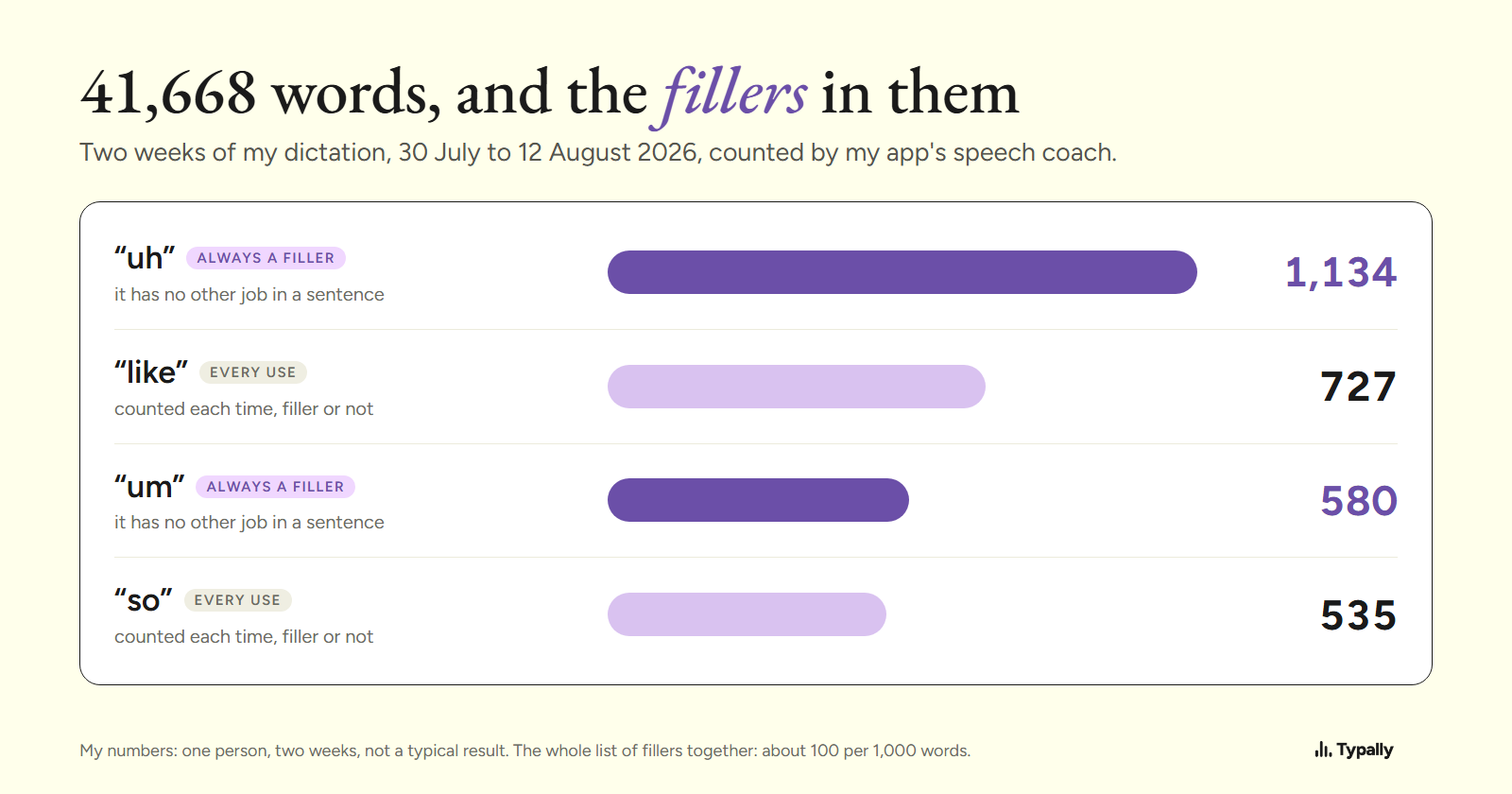
Across the coach's list of 22 words and phrases, that is about 100 fillers per 1,000 words. The count is wide: "like" and "so" are counted every time, filler or not. "Um" and "uh" alone are about 41 per 1,000, or one word in 24.
This is dictation, which I use for prompting AI tools. It isn't meeting speech, and it is one person. The coach could count them because the cleanup is switched off on my computer, a story I told on Medium. If you want fewer, see how to stop saying um.
What happens to fillers when you write instead of speak?
They lose their job. Cambridge says "We use different discourse markers in speaking and writing", and lists firstly, in addition and on the other hand for writing. An um announces a delay, and a written message has no delay to announce.
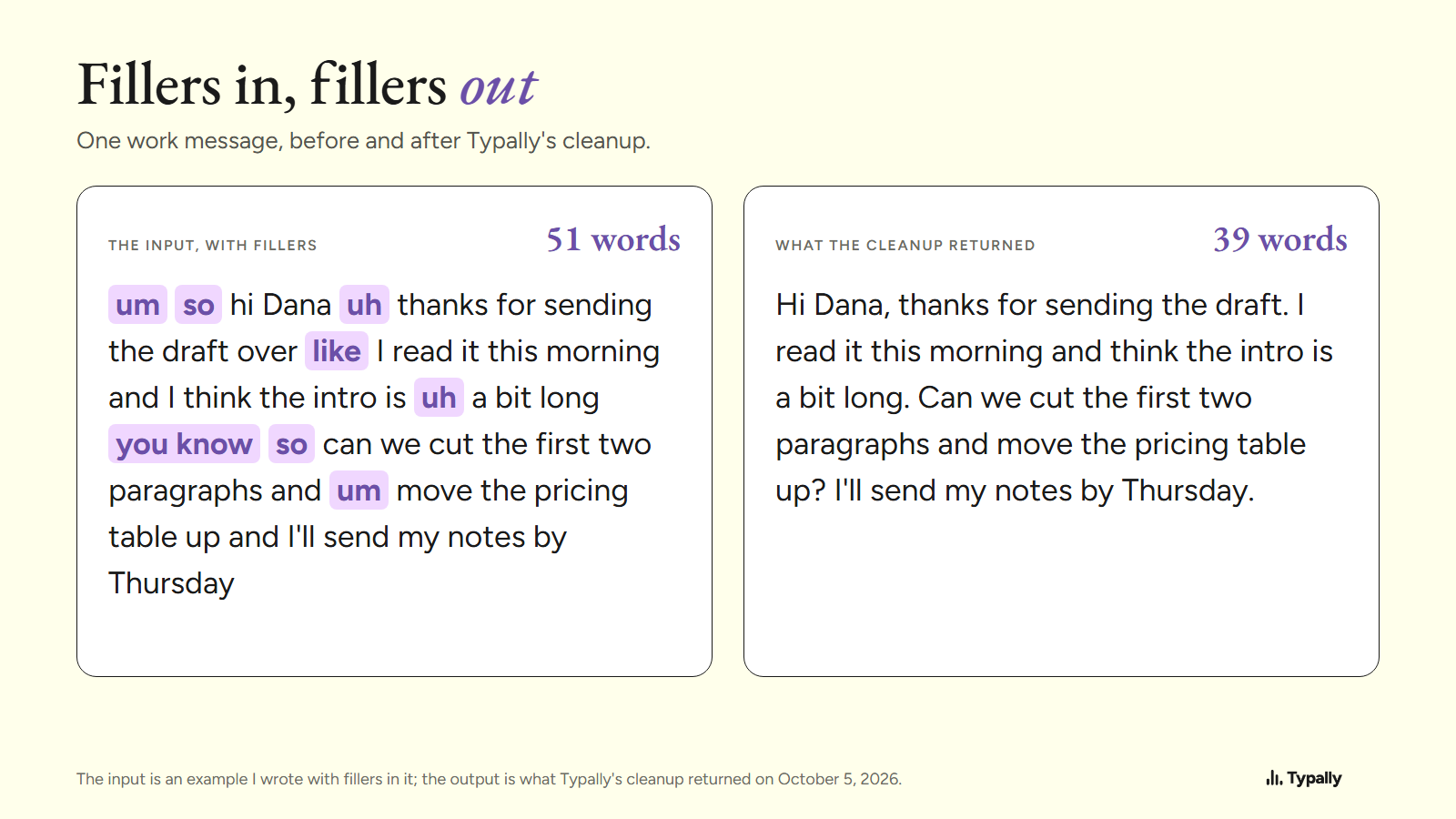
Here is one work message both ways. Its 51 words open "um so hi Dana uh thanks for sending the draft over". Typally's cleanup returned 39, opening "Hi Dana, thanks for sending the draft."
For the written side of work English, see business English for emails and chat.
Which free tools help with English fillers?
Three, as of October 2026: Cambridge's grammar pages, a voice recorder and the dictation built into your computer.
- Cambridge's English Grammar Today is free to read online, with examples for most of the words above. Start there.
- A voice recorder. Record two minutes of yourself explaining a project, then tally your fillers by job. For a one-time check, that is all you need.
- Built-in dictation types what you say. Microsoft's page says that on Copilot+ PCs, in English, Fluid dictation in Windows voice typing "automatically corrects grammar, punctuation, and filler words as you speak". Apple's Dictation page doesn't mention fillers.
Neither page describes a count of your fillers. Our comparison with Windows voice typing has more.
Where does Typally fit?
Typally, voice typing for Mac and Windows, is what I use. Hold your shortcut key, talk, let go, and the text appears where your cursor is. That can be Slack, Gmail, Microsoft Teams, Outlook or any other text box. The cleanup is on by default: it removes the ums and fixes the punctuation and capitals. Since version 0.3.0, the cleanup also names Lithuanian fillers: e, ee, ė and nu.
The speech coach gives a score out of 100 and your fillers per 1,000 words.
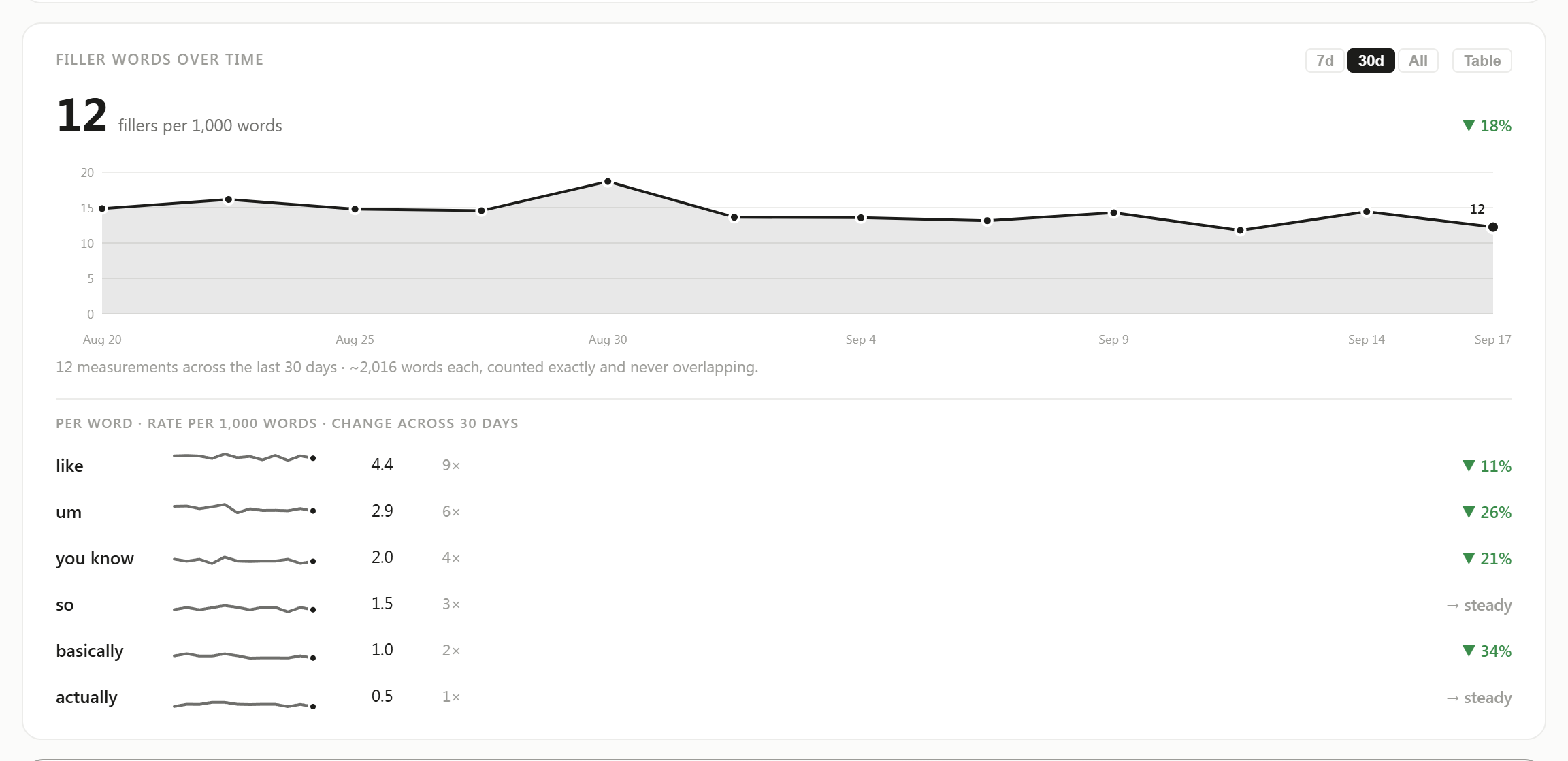
With the cleanup on, the ums are removed before the coach counts. Mine is off, so the coach saw all of them.
It listens only while you hold the key. The audio is discarded after transcription, and your history stays on your computer.
Download Typally free at typally.com for Windows or Mac. The free plan gives you 100 minutes a month and doesn't ask for a card.
What else do people ask about English filler words?
Are filler words a mistake in English?
No. Cambridge lists well, so, like, you know and I mean among the markers that are "very common" in speaking.
Do British and American speakers use different fillers?
A little. Cambridge says "sort of is more common in British English; kind of is more common in American English".
Is Typally free?
There's a free plan with 100 minutes of dictation a month, forever, and it doesn't ask for a card. Pro is $11.99 a month with a 14-day free trial, and the trial needs a card. Or $96 a year.