To use fewer filler words in speech, practice catching each one as you say it, then pause instead. Counting is only the start: two weeks of counting did not lower mine.
In short:
- Eight small studies in the Journal of Applied Behavior Analysis (2016 to 2024) trained speakers to notice their own fillers. Each abstract reports fewer fillers afterward.
- My app counted my fillers for two weeks in 2026: 100.8 per 1,000 words at the start, 107.7 at the end. The count did not lower the rate.
- Fewer fillers is not the same as a better talk. In the 2024 study, expert ratings of 2 speakers did not improve after their fillers fell.
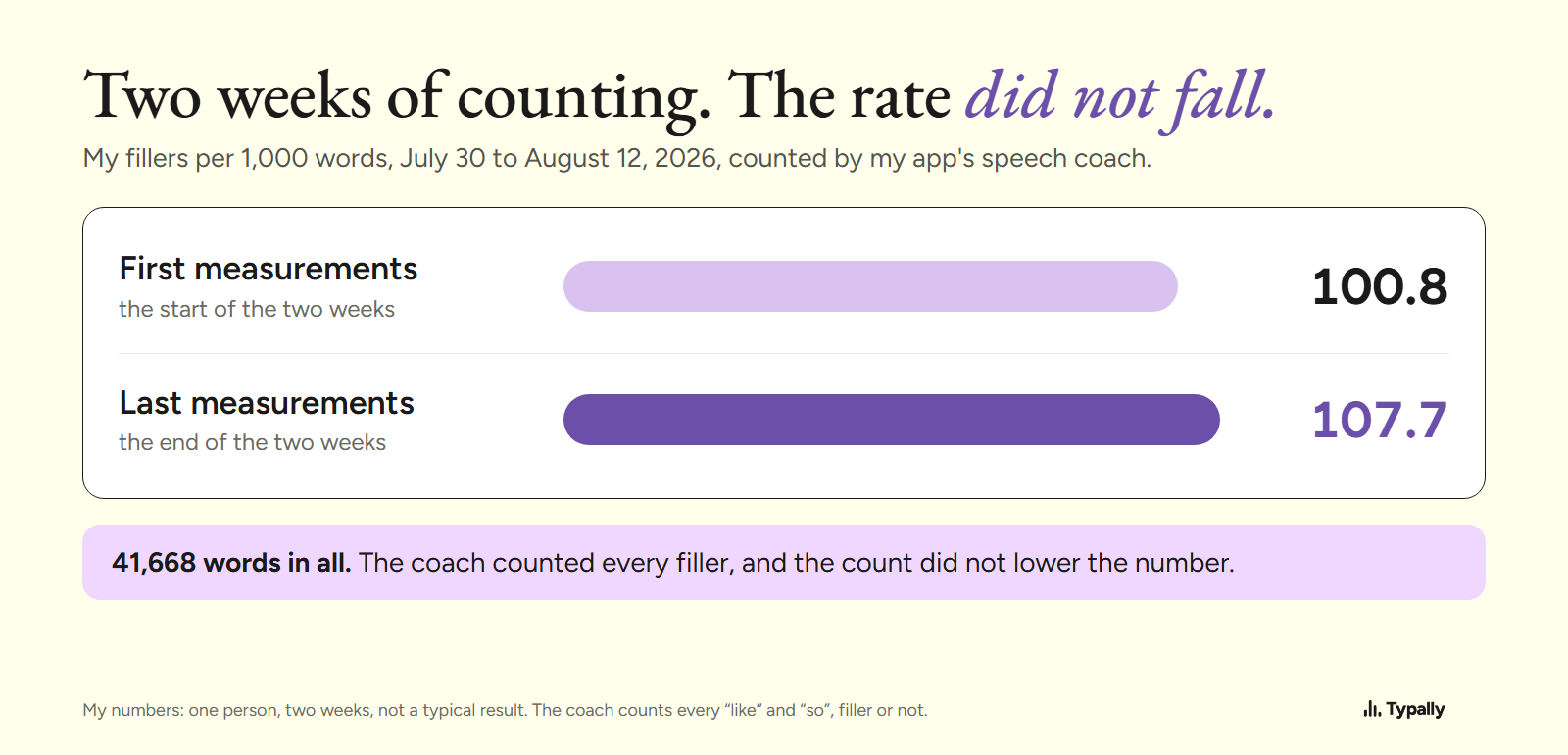
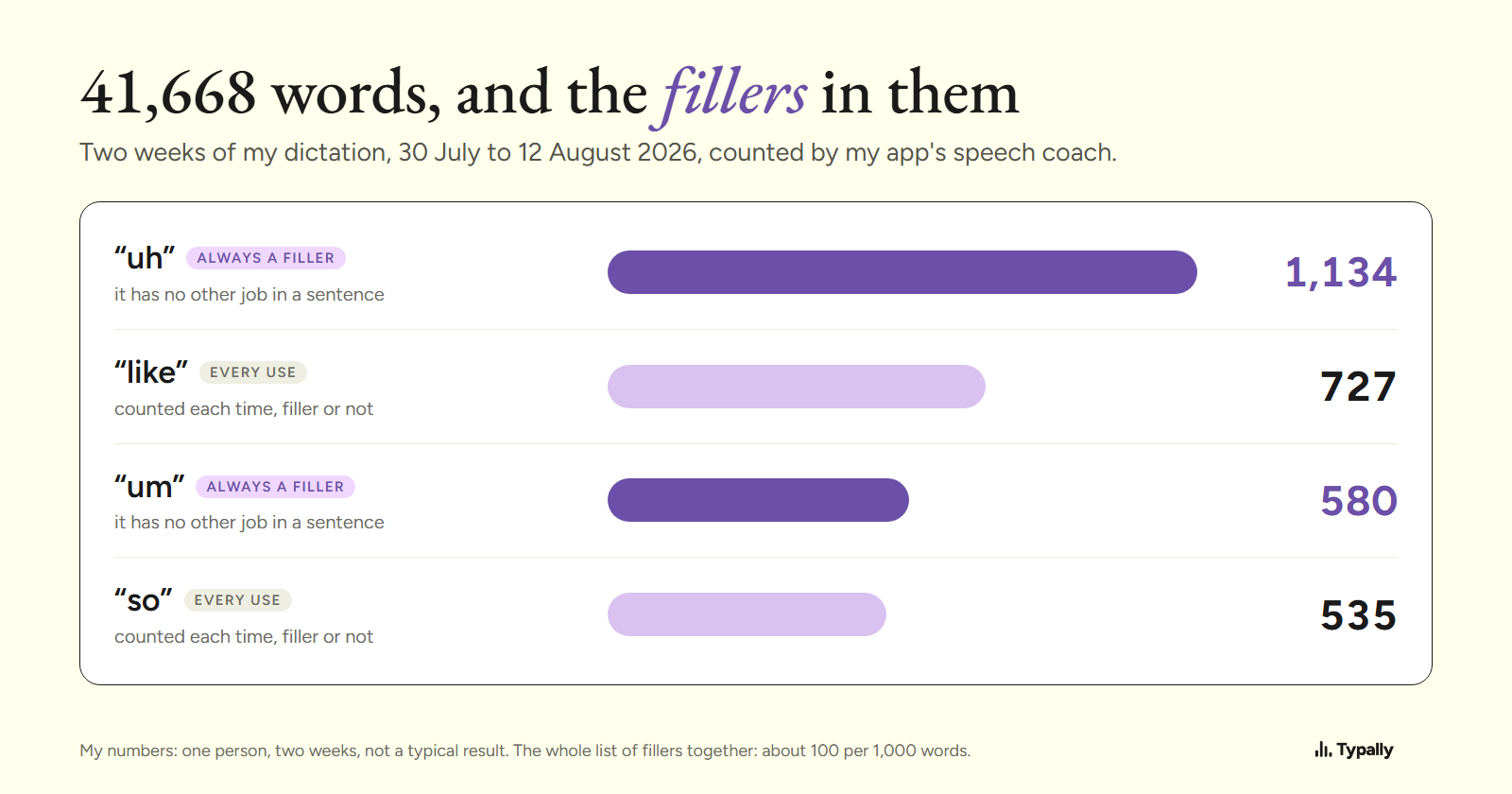
I build Typally, and it comes up near the end. Its speech coach counted two weeks of my dictation, July 30 to August 12, 2026: 41,668 words. That is me talking prompts to AI, not presenting. By the coach's list of 22 words and phrases, I said about 100 fillers per 1,000 words. "Um" and "uh" alone came to about 41 per 1,000, one word in 24.
What lowers filler words in speech, by the studies?
Practice at noticing your own fillers lowers them, in all eight abstracts I read. In the first study, Mancuso and Miltenberger (2016), speakers got "awareness training and competing response training". After it, "all 6 participants exhibited an immediate decrease in filled pauses". Filled pauses there are "uh", "um" or "er", clicking sounds, and misuse of "like".
Later abstracts define the two parts. Awareness training is "identifying speech disfluencies first via a video recording", then during live practice, in Montes and others (2021). The competing response is "a silent pause", in Pawlik and Perrin (2020).
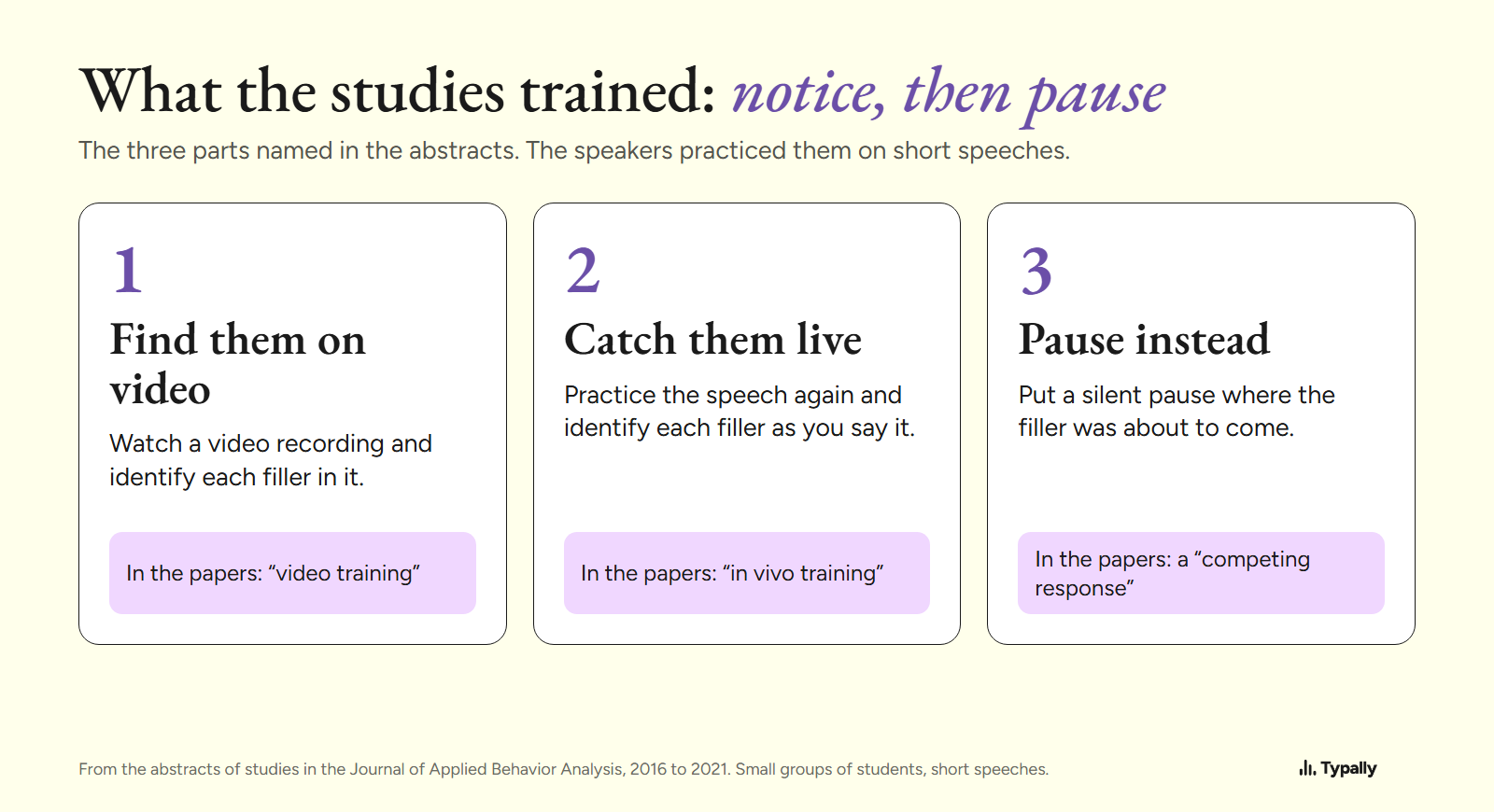
Noticing worked without the pause too. In Spieler and Miltenberger (2017), awareness training alone brought "meaningful reductions" for all 4 students. All 4 needed booster sessions to go lower.
These are small studies. Where an abstract gives a number, it is 2 to 9 speakers. Where it says who they were, it is college or university students giving short speeches. None of the abstracts tests a work meeting.
How do you practice before a meeting or a presentation?
Run the same three parts on your own talk, then add a listener.
- Record a run-through and find every filler yourself. Steven D. Cohen's Harvard Extension School post says to "record an upcoming presentation and then watch yourself in action".
- Say it again and catch each filler live. In the 2021 Montes study, live practice was enough for some of the 8 students. Video plus live was "more likely to result in marked behavior change".
- Pause at the two hot spots. Cohen names them: "at the beginning of a statement and in between ideas". His rule is "Pause, think, answer." Hamilton College's Oral Communication Center adds: "Your audience won't notice the pause".
- Ask someone to flag fillers while you speak. Toastmasters gives this job to the Ah-Counter, who notes "overused words or filler sounds". Some clubs ring a bell at each one. A member told Toastmasters' magazine why: "Telling someone they said an um 45 minutes ago is worthless."
Slowing down and knowing your point are common advice. Presentation coach Joel Schwartzberg lists both in the same magazine, introduced with "In my experience". That is one coach's experience, not a study. For pace, see words per minute speaking.
How do you measure filler words in speech?
Count fillers per 1,000 words, on the same kind of talking each time. A rate lets you compare a long day with a short one. By hand, tally the fillers in a recording, divide by its word count, and multiply by 1,000.
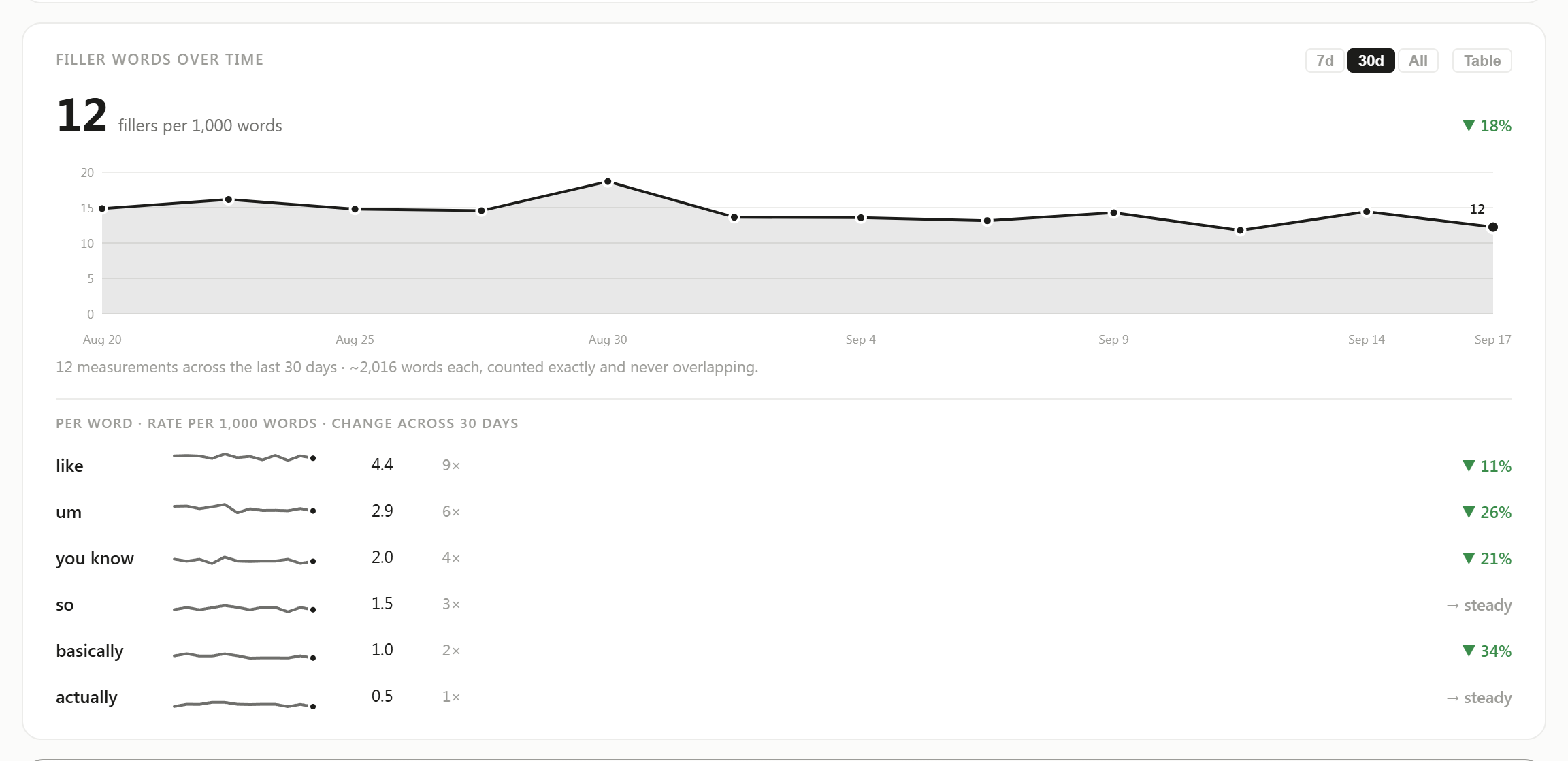
Typally's coach draws that rate as a line and splits it by word. The screen below holds example data: 12 fillers per 1,000 words, from 12 measurements of about 2,016 words each.
Check what your count includes. My coach counts every "like" and "so", filler or not. Sherry Washburn, a club member in the Ah-Counter article above, is stricter. "Be sure you count them only when they are being used as fillers." The hesitation words "um" and "uh" have no other job, so their rate is the cleanest number.
Find your word as well as your rate. Schwartzberg's article says: "Knowing which filler word you rely on is much more valuable than knowing you've said it 13 times." Mine is "uh": 1,134 times in those 41,668 words.
Does counting alone lower your filler words?
It did not lower mine. The rate was 100.8 per 1,000 words in the first measurements and 107.7 in the last. I don't read the small rise as a trend.
Schwartzberg expected as much: "simply knowing and counting your crutches may not be enough". He compares it to "asking someone to control his sneezing by having him count his sneezes".
In the studies, the speakers found each filler themselves, during practice. My count arrived later, as a number on a screen. That may be the difference, but one person over two weeks proves nothing.
The count gave me the size of the habit and the word. It did not do the practice for me.
Which free tools count filler words?
A recorder and a tally are free, and PowerPoint has a rehearsal coach. As of October 2026, Microsoft's page says Speaker Coach "evaluates your pacing, pitch, your use of filler words" and more. It gives guidance on screen as you speak, then a report. The page says you can open a presentation for free in PowerPoint for the web.
For rehearsing a slide talk, it is the better pick: the feedback comes while you speak. Its limits, by the same page: it "only understands English", and "After you close the rehearsal report, it disappears." Take a screenshot if you want to compare weeks.
Where does Typally fit?
Typally, voice typing for Mac and Windows, types what you say into any app. Hold your shortcut key, talk, let go. Its speech coach gives a score out of 100 and your fillers per 1,000 words, from the dictation you already do. That can be a Slack reply, a Teams message or a ChatGPT prompt.
The cleanup is a separate thing. It is on by default, removes the ums, and fixes the punctuation and capitals.
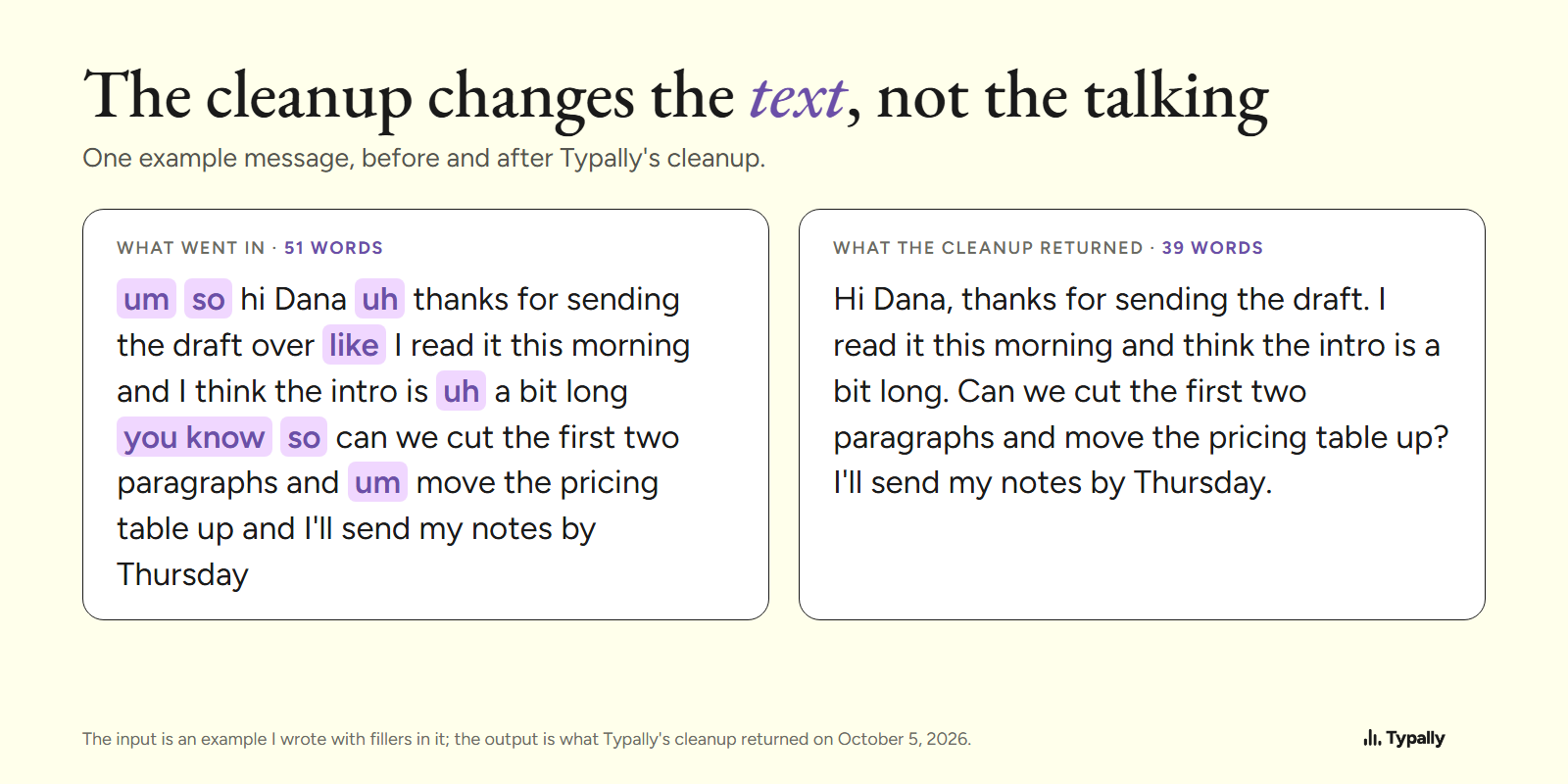
That changes the text, not your talking. The coach counts fillers in the text Typally types. On my own computer the cleanup is switched off, which is why it could count mine. I told that story on Medium. To count yours the same way, switch the cleanup off while you measure.
Typally listens only while you hold the key. The audio is discarded after transcription, and your history stays on your computer.
Download Typally free at typally.com for Windows or Mac. The free plan gives you 100 minutes a month and doesn't ask for a card.
What else do people ask about filler words in speaking?
Are filler words bad in presentations?
Less than you may fear, by one small study. In Laske and others (2024), training cut fillers for both speakers, yet expert ratings "did not improve and some worsened". What filler words are, with a full list, is its own guide.
How long does it take to stop saying um?
No source I read gives a date. Mancuso and Miltenberger report an "immediate decrease" after training, and Spieler's 4 students needed booster sessions. My two weeks of counting moved nothing.
What can you say instead of um?
Nothing: pause. Cohen's line is "If you are not speaking, you can't say 'um'!" If you are learning English and want phrases for work, see English filler words.
Is Typally free?
There is a free plan with 100 minutes of dictation a month, forever, and it doesn't ask for a card. It includes the speech coach. Pro has a 14-day free trial, and the trial needs a card.