Filler words are sounds, words and short phrases, such as um, like and you know, that fill a pause in speech. Take one out and the sentence still says the same thing.
In short:
- A filler word fills a gap while you think: um, uh, like, so, you know.
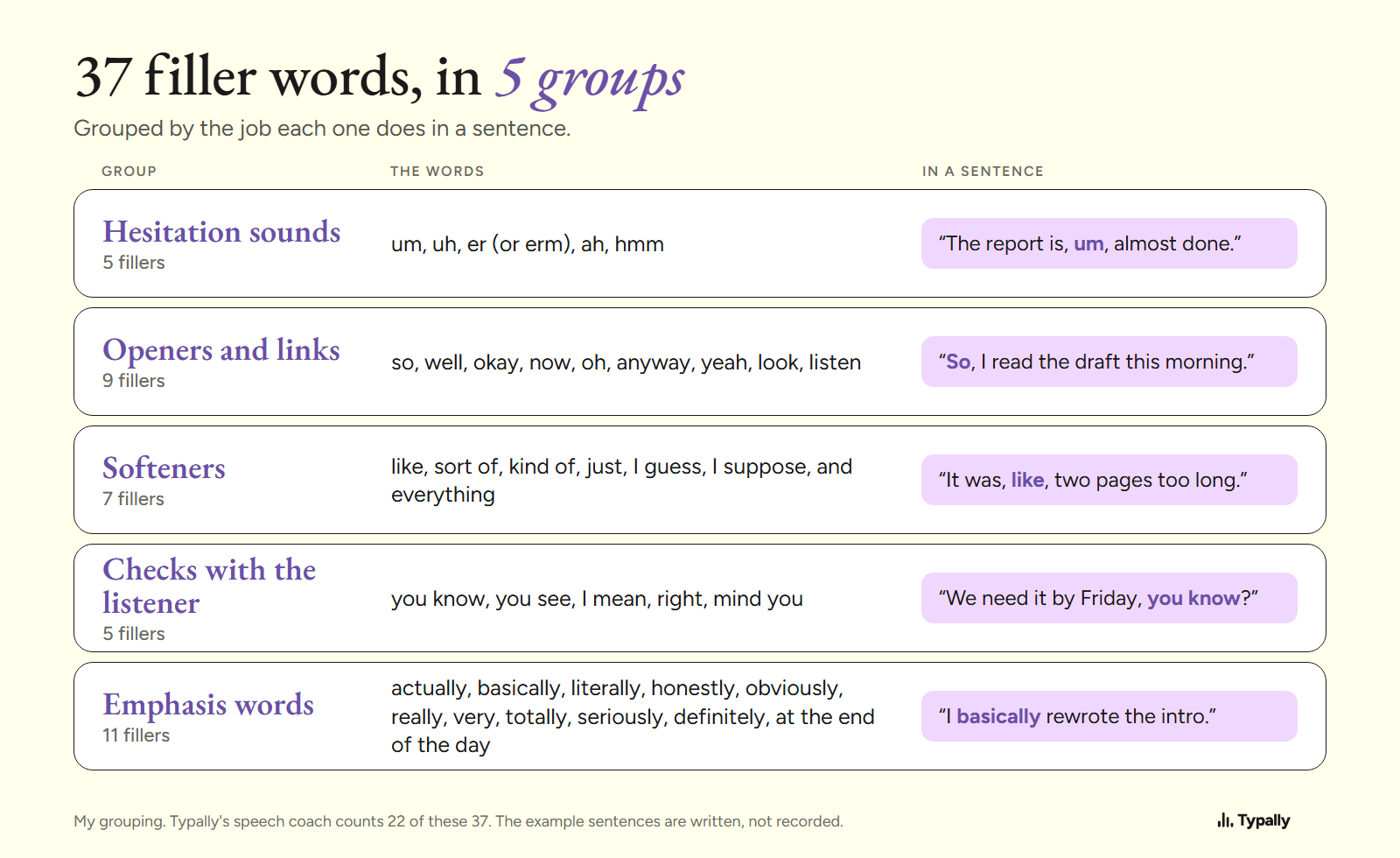
- Researchers split fillers into filled pauses (uh, um) and discourse markers (I mean, you know, like). The list below has 37 in 5 groups.
- In 41,668 words of my own dictation, "uh" and "um" came up 1,714 times: one word in 24. By a wider list of 22 fillers, about one in 10.
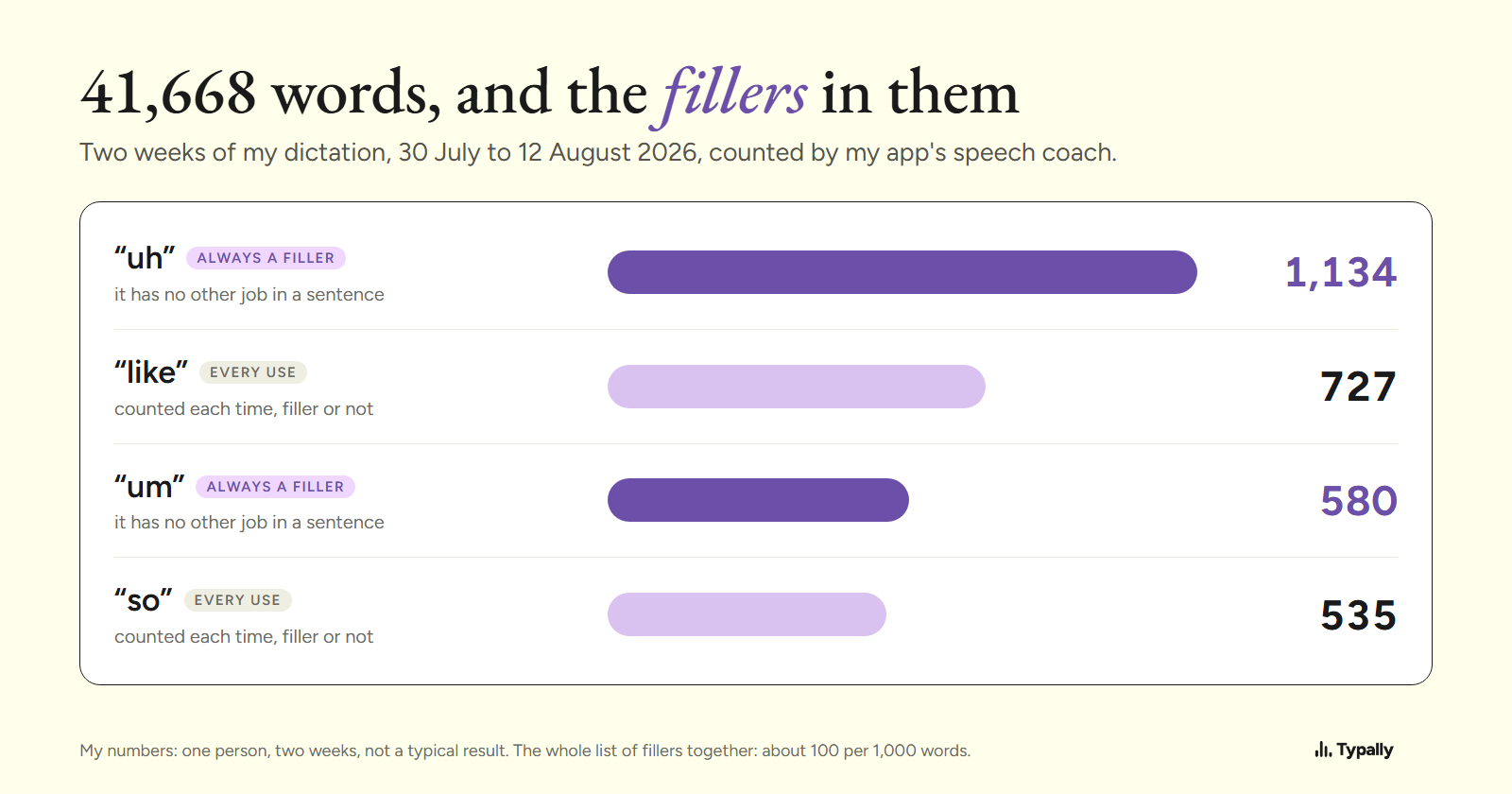
I build Typally, a voice typing app, and it comes up near the end. Its speech coach made that count. My cleanup switch is off, so my fillers stayed in the text (the story is on Medium).
What does "filler words" mean?
It means anything you say to fill a pause that the sentence does not need. That covers sounds (um, uh), single words (like, so, well) and phrases (you know, I mean).
Linguists who study fillers do not treat them as noise. In a 2002 paper in the journal Cognition, Herbert Clark and Jean Fox Tree argue that "uh and um are conventional English words". Speakers use them to announce a delay: a minor one with uh, a major one with um.
Listeners use the signal. In Fox Tree's 2001 experiment, 34 English speakers recognized a word faster after an uh. An um neither helped nor hurt.
Fillers come in two families. A 2014 study looked at five common fillers in 263 transcripts of everyday talk. They fell into two groups: "filled pauses (uh, um) and discourse markers (I mean, you know, like)". Filled pauses came at similar rates across ages and genders. Discourse markers were more common among women, younger people and more conscientious people.
What do filler words look like in a sentence?
They show up at the start of a sentence, between two thoughts, or just before a hard word. Clark and Fox Tree open their paper with a real case: a British academic, recorded while answering a question. Tidied up, his answer reads:
Well, Mallet said he felt it would be a good thing if Oscar went.
Here is what he said, in the researchers' transcript. A period marks a short pause, and "u:h" is a stretched uh.
well, . I mean this . uh Mallet said Mallet was uh said something about uh you know he felt it would be a good thing if u:h . if Oscar went,
A 14-word answer took 29 words, with 4 uhs, one "I mean" and one "you know".
The first text below is an example I wrote with fillers in it. The second is what Typally's cleanup returned on October 5, 2026.
With fillers (62 words)
okay so um I need you to write a follow up email to a client uh his name is Peter and he asked for a quote last week like for a website redesign and we said four thousand dollars and he hasn't replied so um keep it short and friendly you know no pressure and uh ask if he has any questions
After the cleanup (51 words)
Okay, I need you to write a follow-up email to a client. His name is Peter and he asked for a quote last week for a website redesign. We said four thousand dollars and he hasn't replied. Keep it short and friendly, no pressure, and ask if he has any questions.
By my coach's list, the first text has 9 fillers. The cleanup removed 8 and kept the opening "Okay".
Which words belong on a filler words list?
Here are 37 common English fillers, in 5 groups of my own making. No list is complete, because any word can turn into a habit. Researchers draw the lines elsewhere: Fox Tree's 2010 review notes "widespread disagreement about what constitutes a discourse marker".
- Hesitation sounds (5): um, uh, er (or erm), ah, hmm. These have no other job in a sentence.
- Openers and links (9): so, well, okay, now, oh, anyway, yeah, look, listen. Speakers start a sentence with them or join two thoughts.
- Softeners (7): like, sort of, kind of, just, I guess, I suppose, and everything. One proposal in that review: "like" signals "upcoming loose use of language".
- Checks with the listener (5): you know, you see, I mean, right, mind you. In a study the review cites, 77% of people described "you know" as a way to check that the listener follows.
- Emphasis words (11): actually, basically, literally, honestly, obviously, really, very, totally, seriously, definitely, at the end of the day. Most sentences work without them.
Learning English? English filler words covers which ones sound natural at work.
How often do people really say filler words?
It depends on which words you count. My own two weeks gave two very different answers.
The narrow count takes "um" and "uh" only. I said them 1,714 times in 41,668 words. That is 41 per 1,000 words, or one word in 24.
The wide count takes all 22 words and phrases on my coach's list, every time one appears. That gives about 100 per 1,000 words: one in 10.
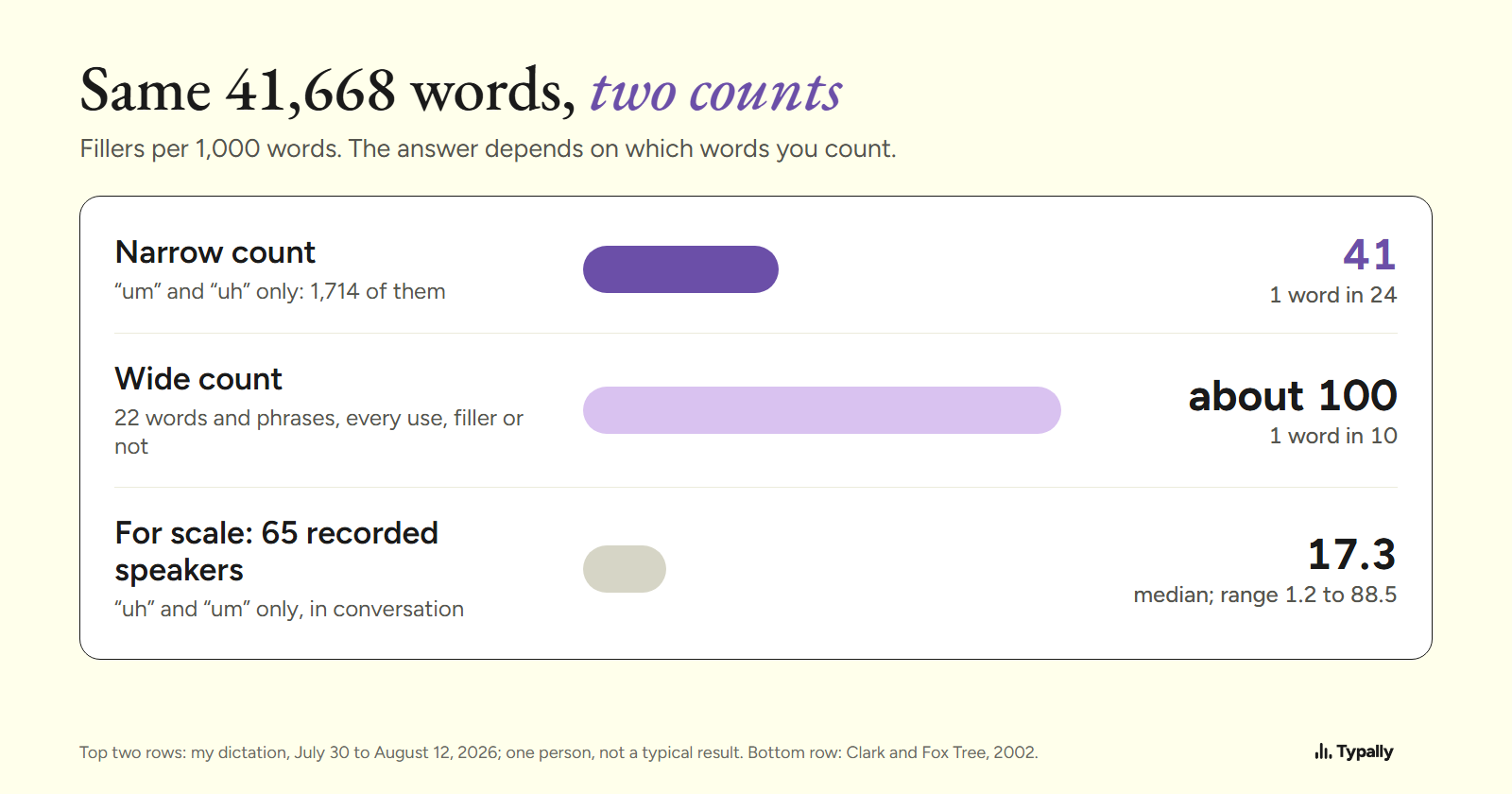
Neither number is exact. The wide count runs high, because it takes "like" (727) and "so" (535) every time, filler or not. The narrow count runs low, because it misses every "you know".
Clark and Fox Tree count the narrow way. In British conversations recorded from 1961 to 1976, 65 speakers ranged from 1.2 to 88.5 uhs and ums per 1,000 words. The median was 17.3. My 41 is inside that range and above the middle. I was alone, dictating to a computer, so it is not a like-for-like match.
How to stop saying um covers what to do about a count you don't like.
What do the free built-in tools do with filler words?
It depends on your computer, as of October 2026. Microsoft's voice typing page describes Fluid dictation, which "automatically corrects grammar, punctuation, and filler words as you speak". Microsoft lists it for Copilot+ PCs, in English. Voice typing itself is built into Windows (Windows key + H).
Apple's Dictation page for Mac says it adds commas, periods and question marks in supported languages. It does not mention filler words. PowerPoint's Speaker Coach "listens for filler words" while you rehearse a talk, by Microsoft's page.
If you write in English on a Copilot+ PC, the built-in tool may be all you need. For rehearsing slides, Speaker Coach is the better pick. Our Windows voice typing comparison has the details.
Where does Typally fit?
Typally, voice typing for Mac and Windows, is what I dictate with. Hold your shortcut key, talk, let go, and the text appears where your cursor is. That can be ChatGPT, Claude, Gmail, Slack or any other text box. The cleanup is on by default: it removes the ums and fixes the punctuation and capitals.
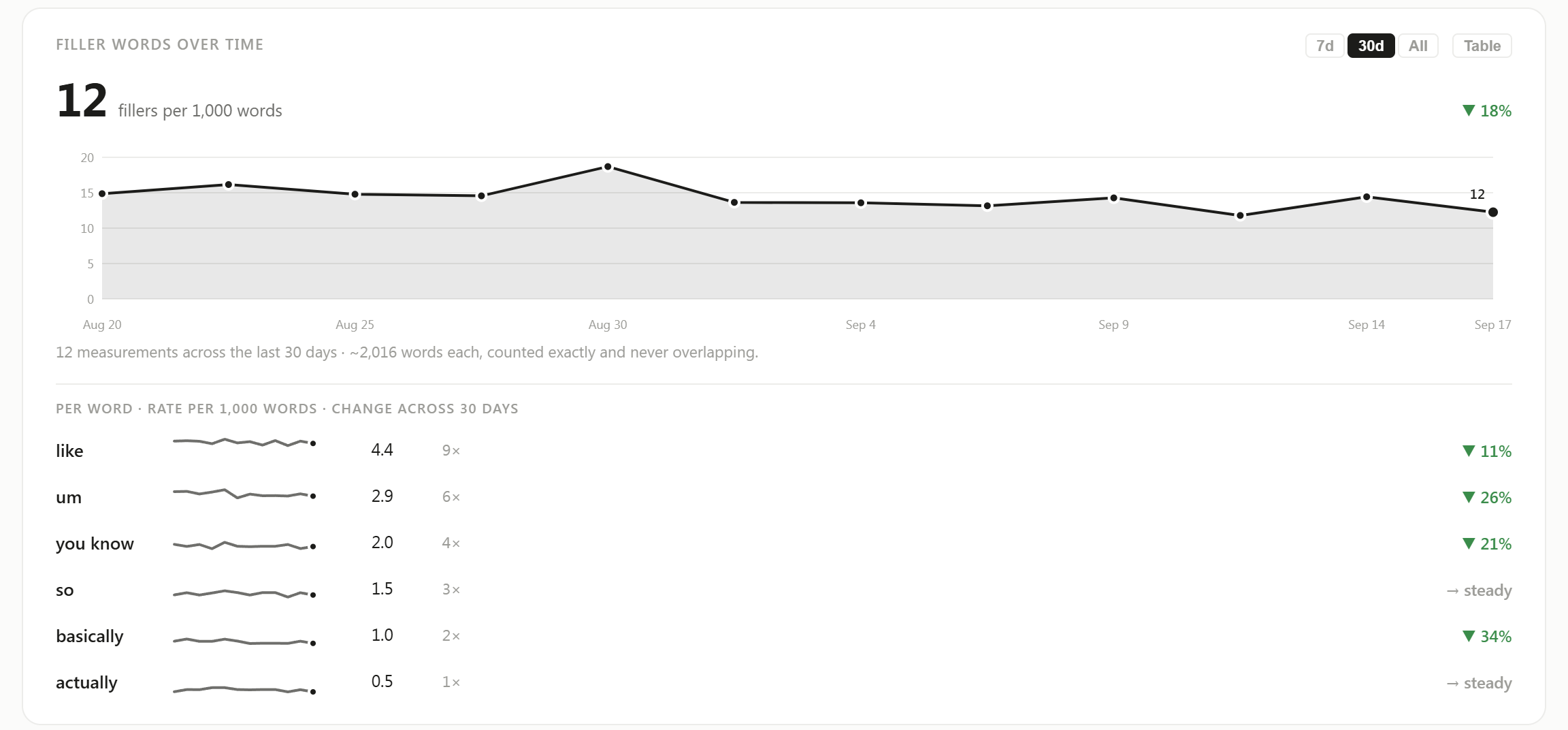
Its speech coach gives a score out of 100 and counts fillers per 1,000 words in the text the app types. That is why my own count needed the cleanup switched off.
It listens only while you hold the key. The audio is discarded after transcription, and your history stays on your computer. It needs an internet connection.
Download Typally free at typally.com for Windows or Mac. The free plan gives you 100 minutes a month and doesn't ask for a card.
What else do people ask about filler words?
Are filler words bad?
Not always: Fox Tree's listeners recognized a word faster after an uh. But in a 2026 study with 360 listeners, speakers who said um and uh were judged less ready and less certain.
Is "like" always a filler word?
No. In "I like the draft" it is a verb. It is a filler only when the sentence works without it, as in "it was, like, two pages too long".
Is Typally free?
There's a free plan with 100 minutes of dictation a month, forever, and it doesn't ask for a card. Pro is $11.99 a month with a 14-day free trial, and the trial needs a card. Or $96 a year.